October 15, 2014

Abraham's Legacy

The legacy of Abraham -- the father of the Jews, the Muslims and the Christians -- carries on in religious wars, jealous stepmothers, feuding families, interracial families, genital mutilation and even child sacrifice.

Abraham's year of birth is unknown, but is likely to be around 1860 BC. He was born in Ur, southern Iraq, to Terah, a wealthy trader in religious idols, and was married to Sarah. Prone to visions and violent outbursts, young Abraham raised the wrath of the king with his religious beliefs and Terah was forced to move the whole family to Haran in Canaan.

In Haran, about ten years later, Abraham and Sarah remained childless and with a vision about numerous descendants he left his father's house, travels to Egypt and back, settles in Hebron, grows rich and distinguishes himself as a warrior king.

Childless and feeling a wretch of a man because of it, Abraham has a vision where his God appears as a smoking torch and commands him to inscribe in blood the sign of the Covenant on his body. The thought of an old man circumcising himself - without anaesthetic or surgical instruments - is frightening; but such was Abraham's belief that in doing so, God's promise about many descendants would come to pass.

In pity at her husband's despair, and what he had done to himself, Sarah offers her black Egyptian slave, Hagar, to Abraham for sex in the hope that a child would ensue, and c.1800 BC, when Abraham was about 60, a son, Ishmael, was born to Abraham and Hagar at Hebron.

Four years later, c.1796 BC, Sarah herself gave birth to the second son of Abraham, Isaac.

Sarah had Ishmael and his mother, Hagar, banished to Mecca but her fury increased when Abraham insisted upon visiting them regularly. He showered them with gifts and raised Hagar's position in the Meccan community to such an extent that she told all and sundry that her son, Ishmael, would sire a great nation of God's people through 12 sons - the 12 Arab tribes.

The tribes of Mecca were indeed the descendants of Ishmael, Abraham's son by Hagar, and from one of these tribes came Mohammed, the founder of Islam. More well known, however -- thanks to Sarah's indoctrination process -- were the 12 tribes of Israel who descended from Isaac through Jacob and Judah, the founder of Judaism.

Basically, the bitter feud that continues today between Jews and Moslems started as a spat between two stepmothers who believed their sons were Abraham's 'favorite' and dutifully poisoned the minds of their sons who, in turn, dutifully poisoned the minds of their sons, ad infinitum.

What made Abraham's story go down in history rests solely upon his fabulous wealth. Sarah and Hagar, the two stepmothers, were more concerned about their status and their sons' inheritance than covenants with imaginary gods!

Labels: , , , , , , , , , , , , , ,

Copyright 2006-2014 Early Civilizations

August 08, 2007

child sacrifice in ancient religions

The practice of sacrificing children was common in most ancient cultures and continued until relatively recent times. The gods, it was believed, demanded the very best of human sacrifices -- so the youngest, the most beautiful or the most favoured of each family's children was destined to lose his or her life on a sacrificial altar in order to ensure the prosperity of the family or community.

These days, of course, such children often lose their innocence on similar religious altars for the base gratification of men of God.

In the bible, when Abraham received a vision from God to take his favourite son to Mt Moriah for sacrifice the Moslems say that Abraham took Ishmael, but the Jews insist it was Isaac.

Whichever boy it was, the sacrifice was not made. The Bible claims that God was testing Abraham's faith, but common sense dictates that the poor old man couldn't bear to part with the sons he had waited so long for.

Actually, it is more likely that Abraham chose his firstborn, Ishmael, for the aborted sacrifice because shortly afterwards a jealous Sarah had Hagar and Ishmael banished. Naturally, after spending four years doting on Ishmael, Abraham had developed a close relationship with Hagar and even when Isaac was born to Sarah he was unlikely to have lost interest in the former slave-girl and her child.

Sarah had expected Ishmael to be sacrificed, and when he came back alive she was furious because her son's inheritance was now at risk.


Read more:


  • feuding families
  • jealous stepmothers


  • Labels: , , , , , , , , , , , , , , ,

    Copyright 2006-2014 Early Civilizations

    December 11, 2006

    abraham's descendants

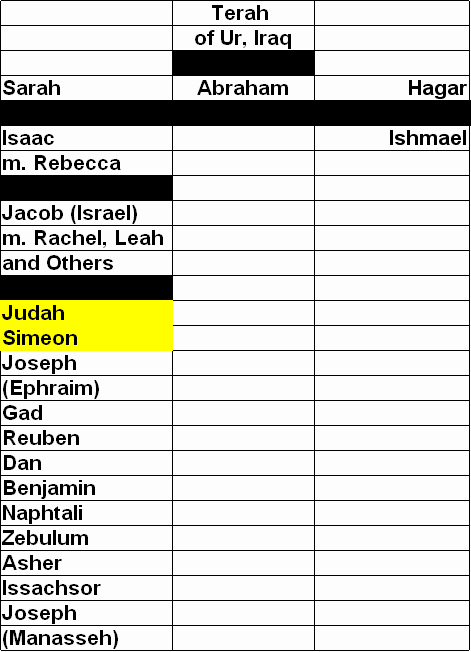
    The following explains the family relationship between the Jews and the Arabs that started about BC 1890 in Ur, Iraq, with Terah, the father of Abraham.

    The tribes of Mecca were the descendants of Ishmael, Abraham's son by Hagar, and from one of these tribes came Mohammed, the founder of Islam.

    The twelve tribes of Israel were the descendants of Isaac, Abraham's son by Sarah, and from Judah -- one of the two remaining of the twelve tribes -- came Jesus, the founder of Christianity.


    Isaac married Rebecca; their son Jacob (Israel) married Rachel, Leah and others.

    From Jacob (Israel)  and his wives came the the twelve tribes, of which only Judah and Simeon are known,

    The ten lost tribes of Isreal are Joseph, Ephraim, Gad, Reuben, Dan, Benjamin, Naphtali, Zebulum, Asher, Issachsor, Manassah.

    Labels: , , , , , , , , , , , , , , , , , ,

    Copyright 2006-2014 Early Civilizations

    jews and moslems are family!

    In that both Jews and Moslems acknowledge Abraham as their founding ancestor, they are essentially of the same Semitic family and inherited not only Abraham's belief in one God but also the Covenant he made with Him.

    Abraham's year of birth is unknown, but is likely to be around 1860 BC. What we do know about Abraham is that he was born in Ur, southern Iraq - during the Sumeric civilization (3500-1700 BC), from which the Babylonian civilization emerged (1500-538 BC) - and was the son of Terah, a wealthy trader in religious idols.

    At an early age, Abraham developed a belief in one God - a belief that was totally alien to his times - and he also had a bad temper. Both his 'strange' belief, his visions and his erratic temper were probably indicative of a mental disorder, and he was therefore lucky to have a loving family to protect him.

    When Abraham became so intolerant of the polytheistic idols in his father's shop that he smashes them in a fit of anger, he raised the wrath of the king who tries to have Abraham burned alive for his disbelief in idolatry.

    Abraham's father, Terah, protects his son by quickly moving the whole family - including his nephew, Lot, and Sarah, Abraham's wife - to Haran in Canaan.

    In Haran, about ten years later, Abraham is commanded by his God to leave his father's house and is promised that his descendants will be numerous. He then travels to Egypt and back, settles in Hebron, grows rich and distinguishes himself as a warrior king - but for all this time he failed to father any children.


    Childless in his old age, and feeling a wretch of a man because of it, Abraham has many visions and conversations with God and finally has a dream where God appears as a smoking torch and commands him to inscribe in blood the sign of the Covenant on his body. The thought of an old man circumcising himself - without anesthetic or surgical instruments - is frightening; but such was Abraham's belief that in doing so, God's promise about many descendants would come to pass.

    The custom of circumcision, then, originated with this Covenant - this plea bargain with God that Abraham made in order to father children.


    In pity at her husband's despair, and what he had done to himself, Sarah offers her Egyptian slave, Hagar, to Abraham for sex - in the hope that a child would ensue. In c.1800 BC, when Abraham was about 60, a son, Ishmael, was born to Abraham and Hagar at Hebron.

    Four years later, c.1796 BC, Sarah herself gave birth to the second son of Abraham, Isaac. The Bible states Sarah's age - like Abraham's - as quite ancient; but common sense dictates that in 1796 BC she was at most 50 and Abraham about 64.

    Abraham was then 'commanded by God' to take his favorite son to Mt Moriah for sacrifice. Actually, the practice of sacrificing children was common at the time and what Abraham was doing was following a pagan custom.

    The Moslems say that Abraham took Ishmael, but the Jews insist it was Isaac, but whichever boy it was, the sacrifice was stayed by God. The Bible claims that God was testing Abraham's faith, but common sense dictates that the poor old man couldn't bear to part with a son he had waited so long for.

    Actually, it is more likely that Abraham chose his firstborn, Ishmael, for the aborted sacrifice because shortly afterwards a jealous Sarah had Hagar and Ishmael banished.


    Ishmael and his slave mother, Hagar, settled in Mecca where Abraham often visited to see his firstborn son. Hagar believed that Ishmael would sire a great nation through 12 sons - the 12 Arab tribes; but the Jews believe that the Covenant only flowed through Isaac and Sarah's lineage.

    The Moslems claim that Ishmael was circumcised - took the blood Covenant - and therefore disenfranchised the Jews. Furthermore, the Moslems claim that God chooses his people on commitment and surrender - not lineage - and that by worshipping the golden calf in the Exodus from Egypt, the Jews proved themselves unworthy of being the Chosen People.


    Mohammed, born 570 AD, the founder of Islam (670 AD), claims to have descended from Ishmael; and Judah, born c.1740 BC, the founder of Judaism (c. 1700 BC), claims to have descended from Isaac through Jacob. Jacob, who changed his name to Israel, was the founder of the nation of Israel and was Isaac and Rebecca's second son. With his two wives and two concubines Jacob fathered 12 sons who, in turn, fathered the 12 tribes of Israel.

    In that part of the world in ancient times - and in some parts, even today - it was the custom for rich men to have many wives and even more concubines and scores if not hundreds of children. Furthermore, in that these were wandering tribes - traveling all over the Middle Eastern lands - their wives and concubines were from all lands, and their children were thus of mixed race.

    Joseph, for instance, was the son of Jacob's 2nd wife, Rachel, and because he was Jacob's favorite he was sold to slave traders by the 6 jealous sons of the 1st wife, Leah, and ended up in Egypt where he gained fame as a dream-reader and became the Pharaoh's 2nd in command. When famine hit Israel, the 6 jealous half-brothers begged for help from Joseph, and he magnanimously forgave them and allowed the Israelites safe passage to Egypt.

    When Seti became King of Egypt in 1304 BC - 43 years after Tutankhamen, 73 years after Akhenaton - he feared the Israelites were outnumbering the Egyptians and ordered all newborn male Israelites to be thrown into the Nile. One child, Moses, was saved and raised by the Pharaoh's daughter, but when Moses grows up and kills an Egyptian for mistreating the Israelites, he flees Egypt but returns when God tells him to lead the Children of Israel out of Egypt. The Pharaoh, Seti's son Rameses II (1290BC - 1224 BC), refuses to free the Israelites, God sends 10 plagues, including the death of every first born Egyptian, including the Pharaoh's, and finally he lets them go, showering them with golden gifts, but changes his mind, goes after Moses, and God saves the Israelites by 'parting' the Red Sea for them to pass through safely.

    In that the ancient Israelites spent time in Egypt and lands now known as Iraq, Syria, Lebanon, Palestine and Saudi Arabia - and freely intermarried or bred with the local people - the likelihood of everyone in the Middle East being closely related to the Jews is significantly higher than it is elsewhere.

    The Moslems and the Jews are indeed not only of the same race but also of the same ancestral families, and as such there is as much bad blood between them now as there was between the families of the Patriarchs.

    Labels: , , , , , , , , , , , , , , , , ,

    Copyright 2006-2014 Early Civilizations