October 15, 2014

Abraham's Legacy

The legacy of Abraham -- the father of the Jews, the Muslims and the Christians -- carries on in religious wars, jealous stepmothers, feuding families, interracial families, genital mutilation and even child sacrifice.

Abraham's year of birth is unknown, but is likely to be around 1860 BC. He was born in Ur, southern Iraq, to Terah, a wealthy trader in religious idols, and was married to Sarah. Prone to visions and violent outbursts, young Abraham raised the wrath of the king with his religious beliefs and Terah was forced to move the whole family to Haran in Canaan.

In Haran, about ten years later, Abraham and Sarah remained childless and with a vision about numerous descendants he left his father's house, travels to Egypt and back, settles in Hebron, grows rich and distinguishes himself as a warrior king.

Childless and feeling a wretch of a man because of it, Abraham has a vision where his God appears as a smoking torch and commands him to inscribe in blood the sign of the Covenant on his body. The thought of an old man circumcising himself - without anaesthetic or surgical instruments - is frightening; but such was Abraham's belief that in doing so, God's promise about many descendants would come to pass.

In pity at her husband's despair, and what he had done to himself, Sarah offers her black Egyptian slave, Hagar, to Abraham for sex in the hope that a child would ensue, and c.1800 BC, when Abraham was about 60, a son, Ishmael, was born to Abraham and Hagar at Hebron.

Four years later, c.1796 BC, Sarah herself gave birth to the second son of Abraham, Isaac.

Sarah had Ishmael and his mother, Hagar, banished to Mecca but her fury increased when Abraham insisted upon visiting them regularly. He showered them with gifts and raised Hagar's position in the Meccan community to such an extent that she told all and sundry that her son, Ishmael, would sire a great nation of God's people through 12 sons - the 12 Arab tribes.

The tribes of Mecca were indeed the descendants of Ishmael, Abraham's son by Hagar, and from one of these tribes came Mohammed, the founder of Islam. More well known, however -- thanks to Sarah's indoctrination process -- were the 12 tribes of Israel who descended from Isaac through Jacob and Judah, the founder of Judaism.

Basically, the bitter feud that continues today between Jews and Moslems started as a spat between two stepmothers who believed their sons were Abraham's 'favorite' and dutifully poisoned the minds of their sons who, in turn, dutifully poisoned the minds of their sons, ad infinitum.

What made Abraham's story go down in history rests solely upon his fabulous wealth. Sarah and Hagar, the two stepmothers, were more concerned about their status and their sons' inheritance than covenants with imaginary gods!

Labels: , , , , , , , , , , , , , ,

Copyright 2006-2014 Early Civilizations

October 09, 2007

Muhammad and Islam

As a likely descendant of Abraham through Ishmael and his Egyptian slave mother, Hagar -- both banished to Mecca by Abraham's jealous wife, Sarah -- Muhammad (c. 570 – 632) was an Arab political and military leader who set himself up as God's final prophet and his followers, under the caliphate, as the world's final rulers.

Initially, Muhammad was neither a Jew nor a Christian. As a youth, he worshipped all of the 360 Pagan gods in the Kabah in Mecca owned and operated by his Quraish tribe. He was just one of thousands of young Arab men from wealthy families who were set adrift as the former Roman provinces, now under the control of Christian bishops, became embroiled in one theological argument after another, leaving a political vacuum.

At some point in his life Muhammad was converted to the concept of monotheism by the Christians, but being a proud Arab he saw more political gain in reforming his native pagan religion than adopting a foreign religion like Christianity. He took the top pagan god of the Kabah in Mecca (called Hubal and/or Allah), chose it to be his new monotheistic god and set about converting all the Arab people to monotheism.

Mohammad's followers claim that Islam was not a new religion but a restoration of the primordial and supreme religion of mankind professed by Adam. To them, Abraham, Moses, Jesus and all of the Hebrew prophets were prophets of Islam, but their message and their texts had become corrupted. All children, according to Islam, are born Muslims, but are converted to another faith by their parents.

In that converts were won by using an existing Pagan deity as the god of Islam -- and Mecca, the home of that deity as the holy place of Islam -- it can be argued that Muslims are not worshipping the same god as the Hebrew prophets and in that respect it was a new religion.

However, Islam -- meaning submission, the total surrender of oneself to God -- is far more like Judaism than Christianity in that it rejects the notion of God begetting or being begotten. Both Jews and Muslims (one who submits to God) totally reject the Christian doctrine of the Trinity -- the father, the son and the holy ghost -- which they compare to polytheism.

By uniting the Arabs with Islam, Muhammad believed that the Arabs could easily conquer all of the former Roman provinces that had been torn asunder by Christian theological arguments. He was a political and military strategist who used religion to further his aims, a fact understood too well by his Quraish tribe in Mecca. For 13 years Muhammad preached to the people of Mecca, imploring them to abandon polytheism, until persecution by the leading Meccan authorities caused him to flee to Medina in 622. Called Hegira, this flight dates the birth of Islam.

In Medina, Muhammad established his political and religious authority by appealing to the many disgruntled, alienated and persecuted people of all faiths from the old Roman provinces who were happy to accept Allah as their god and Mohammad as their leader. He fought two battles against Meccan forces -- the victorious Battle of Badr in 624 and the inconclusive Battle of Uhud in 625 -- and conflict with Jewish clans in Medina led to their exile, enslavement or death.

Finally, by bringing surrounding desert tribes under his control, the Meccan trade routes were cut off and by 629 Muhammad was victorious in the nearly bloodless Conquest of Mecca.

In the last ten years of his life, Muhammad organized 65 military campaigns and personally led 27 of them. The more power he attained, the less the excuse needed to go to battle, until finally he began attacking tribes merely because they were not part of his growing empire. By the time of his death in 632 Muhammad ruled over the Arabian peninsula and left instructions for his followers to press the Jihad against the Hindus, Christians, Jews, Zoroastrians (Persians) and Buddhists.

Beginning at the age of 40 and continuing for the last 23 years of his life Muhammad reported receiving revelations from God. The content of these revelations was memorized and recorded by his companions. Known as the Qur'an (Koran), these revelations, like those of Jesus recorded in the Bible, were undoubtedly embellished and edited according to the political climate and particular aspirations of later Islamic leaders.

In Muslim tradition, Muhammad is believed to be the last and the greatest in a series of prophets, a man closest to perfection and the possessor of all virtues. Muhammad's life is called the Sunnah (the trodden path) and all Muslims are encouraged to emulate his actions in their daily lives.

Muhammad's first wife -- Khadija, a woman much older than himself -- died a few years before he fled to Medina and, at the age of 49, he was betrothed to Aisha, aged six, the daughter of his closest friend, Abu Bakr. Three years later, following an illness that hastened Aisha's first menstrual cycle, he then formally married and sexually consummated his marriage with her. This was in accordance with acceptable custom at that time, Mary the mother of Jesus being not much older than 9.

Aisha was extremely jealous of Muhammad's other wives -- he had 11, despite God telling him that a man may only have four wives -- and she often resorted to conspiring with the other wives, lying and deceiving, in order to keep Muhammad's attention.

After Muhammad’s death, his most faithful followers and even his own family immediately turned on each other -- creating the Shia and Sunni factions -- making one wonder whether they were acting piously by following the Sunnah (emulating Muhammad’s actions) or behaving lawlessly without the slightest regard for the religion they professed to follow.
Aisha was a ringleader in the first Muslim civil war -- the first time Muslims took arms up against other Muslims. In the Battle of the Camel, between Aisha (later the Sunni faction) and Ali ibn Abi Talib -- the cousin and son-in-law of Muhammad (later the Shia faction) -- thousands of Muslims were killed fighting against each other.

Aisha's side lost, and she was put under house arrest by Ali. At the age of 18, Aisha's life was thus virtually over because whereas a man may marry up to four wives if he believes he can treat them equally, a woman may marry one man only. And, as the wife of the Prophet, she was his in this world and the next.

Muhammad’s own daughter, Fatima -- married to Ali ibn Abi Talib, Muhammad’s cousin -- died of stress from persecution within three months of her father's death, and Ali was later assassinated. Their son (Muhammad’s grandson) was killed in battle with the Sunni faction. This slaughter was surely not what Muhammad would have wanted, but without annointing a successor maybe it is exactly what he intended in order to ensure that the next leader was as strong and ruthless as himself.

There were four Caliphs (leaders) in the first twenty-five years. Three of the four were murdered. The third Caliph was murdered by the son of the first. The fourth Caliph was murdered by the fifth, who left a 100-year dynasty that was ended in a gruesome, widespread bloodbath by descendants of Muhammad’s uncle.

Despite it's early horrors -- and four centuries of Muslim armies invading many lands, plundering them and forcing the survivors to either convert or pay tribute at the point of a sword -- the Arabic civilization under the Caliphate was one of the most advanced in the world during the Middle Ages. This was made possible by the monolithic Arab empire giving way to a more religiously homogenized Muslim world respecting the caliph's titular authority yet bringing new legal, philosophical, and religious ideas to Islamic scholarship.

Had Islamic philosophers such as Ibn Sina (Avicenna) and Al-Farabi been allowed to incorporate Greek principles into Islamic theology, relations between the Islamic world and the newly forming western civilization may have taken a less bloody path.


This article first appeared as Islam, a restoration of Abraham's ideal?

Labels: , , , , , , , , , , , , , , , , , , ,

Copyright 2006-2014 Early Civilizations

arabic civilization under the muslim caliphate

As a likely descendant of Abraham through Ishmael and his Egyptian slave mother, Hagar -- both banished to Mecca by Abraham's jealous wife, Sarah -- Muhammad (c. 570 – 632) was an Arab political and military leader who set himself up as God's final prophet and his followers, under the caliphate, as the world's final rulers.

Initially, Muhammad was neither a Jew nor a Christian. As a youth, he worshipped all of the 360 Pagan gods in the Kabah in Mecca owned and operated by his Quraish tribe. He was just one of thousands of young Arab men from wealthy families who were set adrift as the former Roman provinces, now under the control of Christian bishops, became embroiled in one theological argument after another, leaving a political vacuum.

At some point in his life Muhammad was converted to the concept of monotheism by the Christians, but being a proud Arab he saw more political gain in reforming his native pagan religion than adopting a foreign religion like Christianity. He took the top pagan god of the Kabah in Mecca (called Hubal and/or Allah), chose it to be his new monotheistic god and set about converting all the Arab people to monotheism.

Mohammad's followers claim that Islam was not a new religion but a restoration of the primordial and supreme religion of mankind professed by Adam. To them, Abraham, Moses, Jesus and all of the Hebrew prophets were prophets of Islam, but their message and their texts had become corrupted. All children, according to Islam, are born Muslims, but are converted to another faith by their parents.

In that converts were won by using an existing Pagan deity as the god of Islam -- and Mecca, the home of that deity as the holy place of Islam -- it can be argued that Muslims are not worshipping the same god as the Hebrew prophets and in that respect it was a new religion.

However, Islam -- meaning submission, the total surrender of oneself to God -- is far more like Judaism than Christianity in that it rejects the notion of God begetting or being begotten. Both Jews and Muslims (one who submits to God) totally reject the Christian doctrine of the Trinity -- the father, the son and the holy ghost -- which they compare to polytheism.

By uniting the Arabs with Islam, Muhammad believed that the Arabs could easily conquer all of the former Roman provinces that had been torn asunder by Christian theological arguments. He was a political and military strategist who used religion to further his aims, a fact understood too well by his Quraish tribe in Mecca. For 13 years Muhammad preached to the people of Mecca, imploring them to abandon polytheism, until persecution by the leading Meccan authorities caused him to flee to Medina in 622. Called Hegira, this flight dates the birth of Islam.

In Medina, Muhammad established his political and religious authority by appealing to the many disgruntled, alienated and persecuted people of all faiths from the old Roman provinces who were happy to accept Allah as their god and Mohammad as their leader. He fought two battles against Meccan forces -- the victorious Battle of Badr in 624 and the inconclusive Battle of Uhud in 625 -- and conflict with Jewish clans in Medina led to their exile, enslavement or death.

Finally, by bringing surrounding desert tribes under his control, the Meccan trade routes were cut off and by 629 Muhammad was victorious in the nearly bloodless Conquest of Mecca.

In the last ten years of his life, Muhammad organized 65 military campaigns and personally led 27 of them. The more power he attained, the less the excuse needed to go to battle, until finally he began attacking tribes merely because they were not part of his growing empire. By the time of his death in 632 Muhammad ruled over the Arabian peninsula and left instructions for his followers to press the Jihad against the Hindus, Christians, Jews, Zoroastrians (Persians) and Buddhists.

Beginning at the age of 40 and continuing for the last 23 years of his life Muhammad reported receiving revelations from God. The content of these revelations was memorized and recorded by his companions. Known as the Qur'an (Koran), these revelations, like those of Jesus recorded in the Bible, were undoubtedly embellished and edited according to the political climate and particular aspirations of later Islamic leaders.

In Muslim tradition, Muhammad is believed to be the last and the greatest in a series of prophets, a man closest to perfection and the possessor of all virtues. Muhammad's life is called the Sunnah (the trodden path) and all Muslims are encouraged to emulate his actions in their daily lives.

Muhammad's first wife -- Khadija, a woman much older than himself -- died a few years before he fled to Medina and, at the age of 49, he was betrothed to Aisha, aged six, the daughter of his closest friend, Abu Bakr. Three years later, following an illness that hastened Aisha's first menstrual cycle, he then formally married and sexually consummated his marriage with her. This was in accordance with acceptable custom at that time, Mary the mother of Jesus being not much older than 9.

Aisha was extremely jealous of Muhammad's other wives -- he had 11, despite God telling him that a man may only have four wives -- and she often resorted to conspiring with the other wives, lying and deceiving, in order to keep Muhammad's attention.

After Muhammad’s death, his most faithful followers and even his own family immediately turned on each other -- creating the Shia and Sunni factions -- making one wonder whether they were acting piously by following the Sunnah (emulating Muhammad’s actions) or behaving lawlessly without the slightest regard for the religion they professed to follow.

Aisha was a ringleader in the first Muslim civil war -- the first time Muslims took arms up against other Muslims. In the Battle of the Camel, between Aisha (later the Sunni faction) and Ali ibn Abi Talib -- the cousin and son-in-law of Muhammad (later the Shia faction) -- thousands of Muslims were killed fighting against each other.

Aisha's side lost, and she was put under house arrest by Ali. At the age of 18, Aisha's life was thus virtually over because whereas a man may marry up to four wives if he believes he can treat them equally, a woman may marry one man only. And, as the wife of the Prophet, she was his in this world and the next.

Muhammad’s own daughter, Fatima -- married to Ali ibn Abi Talib, Muhammad’s cousin -- died of stress from persecution within three months of her father's death, and Ali was later assassinated. Their son (Muhammad’s grandson) was killed in battle with the Sunni faction. This slaughter was surely not what Muhammad would have wanted, but without annointing a successor maybe it is exactly what he intended in order to ensure that the next leader was as strong and ruthless as himself.

There were four Caliphs (leaders) in the first twenty-five years. Three of the four were murdered. The third Caliph was murdered by the son of the first. The fourth Caliph was murdered by the fifth, who left a 100-year dynasty that was ended in a gruesome, widespread bloodbath by descendants of Muhammad’s uncle.

Despite it's early horrors -- and four centuries of Muslim armies invading many lands, plundering them and forcing the survivors to either convert or pay tribute at the point of a sword -- the Arabic civilization under the Caliphate was one of the most advanced in the world during the Middle Ages. This was made possible by the monolithic Arab empire giving way to a more religiously homogenized Muslim world respecting the caliph's titular authority yet bringing new legal, philosophical, and religious ideas to Islamic scholarship.

Had Islamic philosophers such as Ibn Sina (Avicenna) and Al-Farabi been allowed to incorporate Greek principles into Islamic theology, relations between the Islamic world and the newly forming western civilization may have taken a less bloody path.


This article first appeared as Islam, a restoration of Abraham's ideal?

Labels: , , , , , , , , , , , , , , , , , , ,

Copyright 2006-2014 Early Civilizations

Islam, a restoration of Abraham's ideal?

As a likely descendant of Abraham through Ishmael and his Egyptian slave mother, Hagar -- both banished to Mecca by Abraham's jealous wife, Sarah -- Muhammad (c. 570 – 632) was an Arab political and military leader who set himself up as God's final prophet and his followers, under the caliphate, as the world's final rulers.

Initially, Muhammad was neither a Jew nor a Christian. As a youth, he worshipped all of the 360 Pagan gods in the Kabah in Mecca owned and operated by his Quraish tribe. He was just one of thousands of young Arab men from wealthy families who were set adrift as the former Roman provinces, now under the control of Christian bishops, became embroiled in one theological argument after another, leaving a political vacuum.

At some point in his life Muhammad was converted to the concept of monotheism by the Christians, but being a proud Arab he saw more political gain in reforming his native pagan religion than adopting a foreign religion like Christianity. He took the top pagan god of the Kabah in Mecca (called Hubal and/or Allah), chose it to be his new monotheistic god and set about converting all the Arab people to monotheism.

Mohammad's followers claim that Islam was not a new religion but a restoration of the primordial and supreme religion of mankind professed by Adam. To them, Abraham, Moses, Jesus and all of the Hebrew prophets were prophets of Islam, but their message and their texts had become corrupted. All children, according to Islam, are born Muslims, but are converted to another faith by their parents.

In that converts were won by using an existing Pagan deity as the god of Islam -- and Mecca, the home of that deity as the holy place of Islam -- it can be argued that Muslims are not worshipping the same god as the Hebrew prophets and in that respect it was a new religion.

However, Islam -- meaning submission, the total surrender of oneself to God -- is far more like Judaism than Christianity in that it rejects the notion of God begetting or being begotten. Both Jews and Muslims (one who submits to God) totally reject the Christian doctrine of the Trinity -- the father, the son and the holy ghost -- which they compare to polytheism.

By uniting the Arabs with Islam, Muhammad believed that the Arabs could easily conquer all of the former Roman provinces that had been torn asunder by Christian theological arguments. He was a political and military strategist who used religion to further his aims, a fact understood too well by his Quraish tribe in Mecca. For 13 years Muhammad preached to the people of Mecca, imploring them to abandon polytheism, until persecution by the leading Meccan authorities caused him to flee to Medina in 622. Called Hegira, this flight dates the birth of Islam.

In Medina, Muhammad established his political and religious authority by appealing to the many disgruntled, alienated and persecuted people of all faiths from the old Roman provinces who were happy to accept Allah as their god and Mohammad as their leader. He fought two battles against Meccan forces -- the victorious Battle of Badr in 624 and the inconclusive Battle of Uhud in 625 -- and conflict with Jewish clans in Medina led to their exile, enslavement or death.

Finally, by bringing surrounding desert tribes under his control, the Meccan trade routes were cut off and by 629 Muhammad was victorious in the nearly bloodless Conquest of Mecca.

In the last ten years of his life, Muhammad organized 65 military campaigns and personally led 27 of them. The more power he attained, the less the excuse needed to go to battle, until finally he began attacking tribes merely because they were not part of his growing empire. By the time of his death in 632 Muhammad ruled over the Arabian peninsula and left instructions for his followers to press the Jihad against the Hindus, Christians, Jews, Zoroastrians (Persians) and Buddhists.

Beginning at the age of 40 and continuing for the last 23 years of his life Muhammad reported receiving revelations from God. The content of these revelations was memorized and recorded by his companions. Known as the Qur'an (Koran), these revelations, like those of Jesus recorded in the Bible, were undoubtedly embellished and edited according to the political climate and particular aspirations of later Islamic leaders.

In Muslim tradition, Muhammad is believed to be the last and the greatest in a series of prophets, a man closest to perfection and the possessor of all virtues. Muhammad's life is called the Sunnah (the trodden path) and all Muslims are encouraged to emulate his actions in their daily lives.

Muhammad's first wife -- Khadija, a woman much older than himself -- died a few years before he fled to Medina and, at the age of 49, he was betrothed to Aisha, aged six, the daughter of his closest friend, Abu Bakr. Three years later, following an illness that hastened Aisha's first menstrual cycle, he then formally married and sexually consummated his marriage with her. This was in accordance with acceptable custom at that time, Mary the mother of Jesus being not much older than 9.

Aisha was extremely jealous of Muhammad's other wives -- he had 11, despite God telling him that a man may only have four wives -- and she often resorted to conspiring with the other wives, lying and deceiving, in order to keep Muhammad's attention.

After Muhammad’s death, his most faithful followers and even his own family immediately turned on each other -- creating the Shia and Sunni factions -- making one wonder whether they were acting piously by following the Sunnah (emulating Muhammad’s actions) or behaving lawlessly without the slightest regard for the religion they professed to follow.
Aisha was a ringleader in the first Muslim civil war -- the first time Muslims took arms up against other Muslims. In the Battle of the Camel, between Aisha (later the Sunni faction) and Ali ibn Abi Talib -- the cousin and son-in-law of Muhammad (later the Shia faction) -- thousands of Muslims were killed fighting against each other.

Aisha's side lost, and she was put under house arrest by Ali. At the age of 18, Aisha's life was thus virtually over because whereas a man may marry up to four wives if he believes he can treat them equally, a woman may marry one man only. And, as the wife of the Prophet, she was his in this world and the next.

Muhammad’s own daughter, Fatima -- married to Ali ibn Abi Talib, Muhammad’s cousin -- died of stress from persecution within three months of her father's death, and Ali was later assassinated. Their son (Muhammad’s grandson) was killed in battle with the Sunni faction. This slaughter was surely not what Muhammad would have wanted, but without annointing a successor maybe it is exactly what he intended in order to ensure that the next leader was as strong and ruthless as himself.

There were four Caliphs (leaders) in the first twenty-five years. Three of the four were murdered. The third Caliph was murdered by the son of the first. The fourth Caliph was murdered by the fifth, who left a 100-year dynasty that was ended in a gruesome, widespread bloodbath by descendants of Muhammad’s uncle.

Despite it's early horrors -- and four centuries of Muslim armies invading many lands, plundering them and forcing the survivors to either convert or pay tribute at the point of a sword -- the Arabic civilization under the Caliphate was one of the most advanced in the world during the Middle Ages. This was made possible by the monolithic Arab empire giving way to a more religiously homogenized Muslim world respecting the caliph's titular authority yet bringing new legal, philosophical, and religious ideas to Islamic scholarship.

Had Islamic philosophers such as Ibn Sina (Avicenna) and Al-Farabi been allowed to incorporate Greek principles into Islamic theology, relations between the Islamic world and the newly forming western civilization may have taken a less bloody path.

Labels: , , , , , , , , , , , , , , , , , , ,

Copyright 2006-2014 Early Civilizations

August 08, 2007

child sacrifice in ancient religions

The practice of sacrificing children was common in most ancient cultures and continued until relatively recent times. The gods, it was believed, demanded the very best of human sacrifices -- so the youngest, the most beautiful or the most favoured of each family's children was destined to lose his or her life on a sacrificial altar in order to ensure the prosperity of the family or community.

These days, of course, such children often lose their innocence on similar religious altars for the base gratification of men of God.

In the bible, when Abraham received a vision from God to take his favourite son to Mt Moriah for sacrifice the Moslems say that Abraham took Ishmael, but the Jews insist it was Isaac.

Whichever boy it was, the sacrifice was not made. The Bible claims that God was testing Abraham's faith, but common sense dictates that the poor old man couldn't bear to part with the sons he had waited so long for.

Actually, it is more likely that Abraham chose his firstborn, Ishmael, for the aborted sacrifice because shortly afterwards a jealous Sarah had Hagar and Ishmael banished. Naturally, after spending four years doting on Ishmael, Abraham had developed a close relationship with Hagar and even when Isaac was born to Sarah he was unlikely to have lost interest in the former slave-girl and her child.

Sarah had expected Ishmael to be sacrificed, and when he came back alive she was furious because her son's inheritance was now at risk.


Read more:


  • feuding families
  • jealous stepmothers


  • Labels: , , , , , , , , , , , , , , ,

    Copyright 2006-2014 Early Civilizations

    March 11, 2007

    630-649 Moslems Conquer Eastern Christian Lands


    In this twenty year period the Arabs -- united by the new Moslem faith -- easily conquered all of the former Christian lands that had been torn asunder by Christian theological arguments.

    In 630 Mohammed entered Mecca with an army of Bedouin followers and with so many disgruntled and alienated and persecuted people of all faiths in the old roman provinces, they were happy to accept a new religion and a new leader.

    In 632 Mohammed died in Medina and, like the early Christians, his followers took up the cause with increased fervour.

    The Moslem Arabs took Syria, Palestine and Persia in 637; captured Jerusalem in 638; Egypt in 641; and then took Africa and the Spanish enclave. The Arabs also penetrated central Asia to the frontier of India and China

    The Islamic world was governed by the Ummayad caliphs with their capital at Damascus, and all that was left of the former eastern empire was an area around Constantinople, exclusively Greek, which had by then reverted to its former Greek name -- Byzantium -- and became known as the Byzantium Empire..

    The Islamic invasions aided the Lombards in Italy who, in 643, under King Rothari took over the empire's remaining strongholds in Italy.

    Although theological arguments had dogged the Christian church since its inception, Pope Honorius I (625-638) was responsible for the latest controversy over Monothelitism -- the belief that Christ did not possess simultaneously a divine will and a human will, but only one that he exercised through both his divine and human natures. 


    Labels: , , , , , , , ,

    Copyright 2006-2014 Early Civilizations

    December 11, 2006

    abraham's descendants

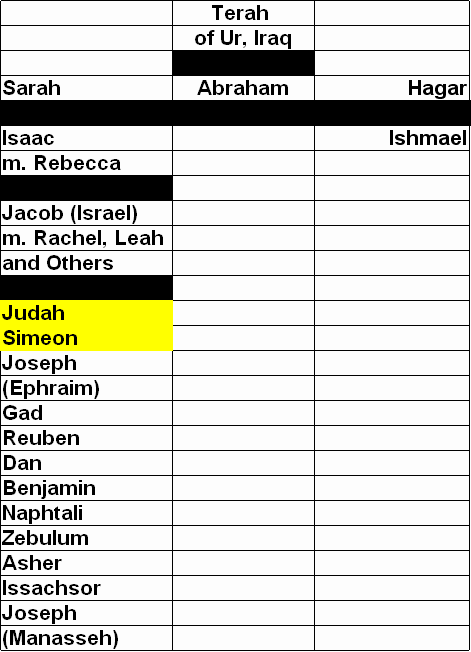
    The following explains the family relationship between the Jews and the Arabs that started about BC 1890 in Ur, Iraq, with Terah, the father of Abraham.

    The tribes of Mecca were the descendants of Ishmael, Abraham's son by Hagar, and from one of these tribes came Mohammed, the founder of Islam.

    The twelve tribes of Israel were the descendants of Isaac, Abraham's son by Sarah, and from Judah -- one of the two remaining of the twelve tribes -- came Jesus, the founder of Christianity.


    Isaac married Rebecca; their son Jacob (Israel) married Rachel, Leah and others.

    From Jacob (Israel)  and his wives came the the twelve tribes, of which only Judah and Simeon are known,

    The ten lost tribes of Isreal are Joseph, Ephraim, Gad, Reuben, Dan, Benjamin, Naphtali, Zebulum, Asher, Issachsor, Manassah.

    Labels: , , , , , , , , , , , , , , , , , ,

    Copyright 2006-2014 Early Civilizations

    jews and moslems are family!

    In that both Jews and Moslems acknowledge Abraham as their founding ancestor, they are essentially of the same Semitic family and inherited not only Abraham's belief in one God but also the Covenant he made with Him.

    Abraham's year of birth is unknown, but is likely to be around 1860 BC. What we do know about Abraham is that he was born in Ur, southern Iraq - during the Sumeric civilization (3500-1700 BC), from which the Babylonian civilization emerged (1500-538 BC) - and was the son of Terah, a wealthy trader in religious idols.

    At an early age, Abraham developed a belief in one God - a belief that was totally alien to his times - and he also had a bad temper. Both his 'strange' belief, his visions and his erratic temper were probably indicative of a mental disorder, and he was therefore lucky to have a loving family to protect him.

    When Abraham became so intolerant of the polytheistic idols in his father's shop that he smashes them in a fit of anger, he raised the wrath of the king who tries to have Abraham burned alive for his disbelief in idolatry.

    Abraham's father, Terah, protects his son by quickly moving the whole family - including his nephew, Lot, and Sarah, Abraham's wife - to Haran in Canaan.

    In Haran, about ten years later, Abraham is commanded by his God to leave his father's house and is promised that his descendants will be numerous. He then travels to Egypt and back, settles in Hebron, grows rich and distinguishes himself as a warrior king - but for all this time he failed to father any children.


    Childless in his old age, and feeling a wretch of a man because of it, Abraham has many visions and conversations with God and finally has a dream where God appears as a smoking torch and commands him to inscribe in blood the sign of the Covenant on his body. The thought of an old man circumcising himself - without anesthetic or surgical instruments - is frightening; but such was Abraham's belief that in doing so, God's promise about many descendants would come to pass.

    The custom of circumcision, then, originated with this Covenant - this plea bargain with God that Abraham made in order to father children.


    In pity at her husband's despair, and what he had done to himself, Sarah offers her Egyptian slave, Hagar, to Abraham for sex - in the hope that a child would ensue. In c.1800 BC, when Abraham was about 60, a son, Ishmael, was born to Abraham and Hagar at Hebron.

    Four years later, c.1796 BC, Sarah herself gave birth to the second son of Abraham, Isaac. The Bible states Sarah's age - like Abraham's - as quite ancient; but common sense dictates that in 1796 BC she was at most 50 and Abraham about 64.

    Abraham was then 'commanded by God' to take his favorite son to Mt Moriah for sacrifice. Actually, the practice of sacrificing children was common at the time and what Abraham was doing was following a pagan custom.

    The Moslems say that Abraham took Ishmael, but the Jews insist it was Isaac, but whichever boy it was, the sacrifice was stayed by God. The Bible claims that God was testing Abraham's faith, but common sense dictates that the poor old man couldn't bear to part with a son he had waited so long for.

    Actually, it is more likely that Abraham chose his firstborn, Ishmael, for the aborted sacrifice because shortly afterwards a jealous Sarah had Hagar and Ishmael banished.


    Ishmael and his slave mother, Hagar, settled in Mecca where Abraham often visited to see his firstborn son. Hagar believed that Ishmael would sire a great nation through 12 sons - the 12 Arab tribes; but the Jews believe that the Covenant only flowed through Isaac and Sarah's lineage.

    The Moslems claim that Ishmael was circumcised - took the blood Covenant - and therefore disenfranchised the Jews. Furthermore, the Moslems claim that God chooses his people on commitment and surrender - not lineage - and that by worshipping the golden calf in the Exodus from Egypt, the Jews proved themselves unworthy of being the Chosen People.


    Mohammed, born 570 AD, the founder of Islam (670 AD), claims to have descended from Ishmael; and Judah, born c.1740 BC, the founder of Judaism (c. 1700 BC), claims to have descended from Isaac through Jacob. Jacob, who changed his name to Israel, was the founder of the nation of Israel and was Isaac and Rebecca's second son. With his two wives and two concubines Jacob fathered 12 sons who, in turn, fathered the 12 tribes of Israel.

    In that part of the world in ancient times - and in some parts, even today - it was the custom for rich men to have many wives and even more concubines and scores if not hundreds of children. Furthermore, in that these were wandering tribes - traveling all over the Middle Eastern lands - their wives and concubines were from all lands, and their children were thus of mixed race.

    Joseph, for instance, was the son of Jacob's 2nd wife, Rachel, and because he was Jacob's favorite he was sold to slave traders by the 6 jealous sons of the 1st wife, Leah, and ended up in Egypt where he gained fame as a dream-reader and became the Pharaoh's 2nd in command. When famine hit Israel, the 6 jealous half-brothers begged for help from Joseph, and he magnanimously forgave them and allowed the Israelites safe passage to Egypt.

    When Seti became King of Egypt in 1304 BC - 43 years after Tutankhamen, 73 years after Akhenaton - he feared the Israelites were outnumbering the Egyptians and ordered all newborn male Israelites to be thrown into the Nile. One child, Moses, was saved and raised by the Pharaoh's daughter, but when Moses grows up and kills an Egyptian for mistreating the Israelites, he flees Egypt but returns when God tells him to lead the Children of Israel out of Egypt. The Pharaoh, Seti's son Rameses II (1290BC - 1224 BC), refuses to free the Israelites, God sends 10 plagues, including the death of every first born Egyptian, including the Pharaoh's, and finally he lets them go, showering them with golden gifts, but changes his mind, goes after Moses, and God saves the Israelites by 'parting' the Red Sea for them to pass through safely.

    In that the ancient Israelites spent time in Egypt and lands now known as Iraq, Syria, Lebanon, Palestine and Saudi Arabia - and freely intermarried or bred with the local people - the likelihood of everyone in the Middle East being closely related to the Jews is significantly higher than it is elsewhere.

    The Moslems and the Jews are indeed not only of the same race but also of the same ancestral families, and as such there is as much bad blood between them now as there was between the families of the Patriarchs.

    Labels: , , , , , , , , , , , , , , , , ,

    Copyright 2006-2014 Early Civilizations