October 15, 2014

Abraham's Legacy

The legacy of Abraham -- the father of the Jews, the Muslims and the Christians -- carries on in religious wars, jealous stepmothers, feuding families, interracial families, genital mutilation and even child sacrifice.

Abraham's year of birth is unknown, but is likely to be around 1860 BC. He was born in Ur, southern Iraq, to Terah, a wealthy trader in religious idols, and was married to Sarah. Prone to visions and violent outbursts, young Abraham raised the wrath of the king with his religious beliefs and Terah was forced to move the whole family to Haran in Canaan.

In Haran, about ten years later, Abraham and Sarah remained childless and with a vision about numerous descendants he left his father's house, travels to Egypt and back, settles in Hebron, grows rich and distinguishes himself as a warrior king.

Childless and feeling a wretch of a man because of it, Abraham has a vision where his God appears as a smoking torch and commands him to inscribe in blood the sign of the Covenant on his body. The thought of an old man circumcising himself - without anaesthetic or surgical instruments - is frightening; but such was Abraham's belief that in doing so, God's promise about many descendants would come to pass.

In pity at her husband's despair, and what he had done to himself, Sarah offers her black Egyptian slave, Hagar, to Abraham for sex in the hope that a child would ensue, and c.1800 BC, when Abraham was about 60, a son, Ishmael, was born to Abraham and Hagar at Hebron.

Four years later, c.1796 BC, Sarah herself gave birth to the second son of Abraham, Isaac.

Sarah had Ishmael and his mother, Hagar, banished to Mecca but her fury increased when Abraham insisted upon visiting them regularly. He showered them with gifts and raised Hagar's position in the Meccan community to such an extent that she told all and sundry that her son, Ishmael, would sire a great nation of God's people through 12 sons - the 12 Arab tribes.

The tribes of Mecca were indeed the descendants of Ishmael, Abraham's son by Hagar, and from one of these tribes came Mohammed, the founder of Islam. More well known, however -- thanks to Sarah's indoctrination process -- were the 12 tribes of Israel who descended from Isaac through Jacob and Judah, the founder of Judaism.

Basically, the bitter feud that continues today between Jews and Moslems started as a spat between two stepmothers who believed their sons were Abraham's 'favorite' and dutifully poisoned the minds of their sons who, in turn, dutifully poisoned the minds of their sons, ad infinitum.

What made Abraham's story go down in history rests solely upon his fabulous wealth. Sarah and Hagar, the two stepmothers, were more concerned about their status and their sons' inheritance than covenants with imaginary gods!

Labels: , , , , , , , , , , , , , ,

Copyright 2006-2014 Early Civilizations

August 22, 2007

the jewish mission

Accepted by all religions is the fact that the first humans created had no religion, and as such any godly plans for humanity were meant for a unified family, not just limited to a chosen few.

Abraham's revolutionary notion of monotheism, a belief in one God, meant that God was not just a God of the Israelites but of all people. God revealed to Abrahamthat his people were to be messengers chosen to bring universal moral instructions to all humanity, not just the Jews.

The Torah was the revelation and the Mitzvot are the divine commandments defining a godly life, and God chose the landless and powerless Jewsas messengers because humans would be free to accept or reject the message on its merits. It was a message delivered without political and economic coercion.

In return for fulfilling their divine mission, God would make the Jews a kingdom of priests and a holy nation.

However, most Talmudic Rabbis do not interpret 'a kingdom of priests' as having universal implications. They believe that the covenant given by God not only provided the core religious content of the message the Jewish people were to convey to humanity but also a separate and distinctcontent designed to force Jews to maintain a separate culture. Being chosen to convey the message implied, to them, a superior position.

By superiority, the Talmudic Rabbis meant that Jews as a separate people were to be a 'light' unto the other nations. In offering the message, they cannot mandate its acceptance. Those who accepted the message choose to become chosen.

The Talmudic Rabbis saw the Jewish mission to convey the message of God, not to convert everyone to Judaism. They did not call for the annihiliation of gentile or non-Jewish religions. They saw salvation as dependent on moral behavior not on accepting Judaism, and accepted that the righteous of all faiths have an equal chance to be saved.

In this sense, the Talmudic Rabbis maintained a separate 'superiority'. They were into delivering the message to all but most certaininly do not believe in wholescale conversions.

However, in the early days of Judaism missionary activity was necessary for the growth of this revolutionary notion of monotheism to take place. In his journey from Haran to Canaan Abraham made many converts. In Deuteronomy 32:10, Abraham is described as so successful a missionary that God became known as King of the earth as well as King of heaven.

However, the word 'convert' is used loosely when referring to Abraham's missionary zeal. The formal notion of religious conversion did not emerge until much later in history. Abraham invited non-Israelites to join the Israelites, as did Isaac and Jacob.

By the time of Moses, the Torah was being expounded in seventy languages, andit provides numerous injunctions to the Jewish people to welcome strangers. It is believed, too, that God exiled Jews from their homeland for only one reason, to increase the number of converts!

Conversions came about through synagogues inviting guests and visitors -- there were thousands of houses of instruction in all towns serving as learning centers for gentiles; Jews were exhorted to personally approach potential converts; gentiles living among Jewish people were invited to assimilate; abandoned gentile children were adopted; and many gentiles converted to Judaism through marriage with a Jew.

The Jewish mission of conversion was also codifed in laws. It is not clear when these legal rules developed, but they most certainly existed after the destruction of the Second Temple when there was a need for clear religious rules to maintain the Jewish identity. So, from 400- 500 AD the existence of these laws indicates that converts were allowed, welcomed and had specific rites to undergo in their conversion.

As expected, conversions were increased during important periods of Jewish history. The Jews grew from 150,000 in 586 BC to more than eight million by the first century of the common era and, in the case of the conversion of the Idumaeans and the Ituraeans, force was uncharacteriscally used.

So widespread was Jewish missionary activty that Greek, Roman, and Christian authors wrote disparagingly about it. In Rome, for example, Tacitus, a rhetorical historian, Cicero, a lawyer, and Juvenal, a satirist, are bitter and serious about denouncing Jewish proselytizing activities, and Horace makes fun of them.

The most famous Christian comment came from Matthew 23:15 in which competition for converts became nasty: "Alas for you scribes and Pharisees, you hypocrites! You travel over sea and land to make a single proselyte and anyone who becomes one you make twice as fit for hell as you are."

By the onset of the Christian era, 10% of the Roman Empire was Jewish and had the Romans and Jews not fought -- the Romans destroying the Temple in 70 AD, crushing the Bar Kochba rebellion in 135 AD and ultimately expelling the Jews from Jerusalem -- the Jews would have succeeded in winning more converts than the Christians and historywould have followed a different path.

While Jewish conversion efforts continued, the stateless and powerless Jews were restricted by Roman, and later Christian and Muslim laws regarding proselytism. In 131 AD, Hadrian prohibited circumcision and public instruction in the Jewish religion. In 198 and 199 the Emperor Severus passed laws forbiddinggentiles from embracing Judaism, and in 335 Constantine re-enacted Hadrian's law, forbidding Jews to circumcise non-Jewish slaves.

Cumulatively, these restrictions not only reversed the general Jewish attitude toward welcoming converts but also produced deep psychological change in the Jewish psyche. By the time of Constantine, many Jews would have embraced Christianity and those that remained faithful to Judaism became insular and messiahanic -- waiting for a messiahto raise them from a miserable existence made more miserable by the triumphant Christians accusing the Jews of Deicide -- killing Jesus -- and setting them up for mockery and persecution.

Christians took over the Jewish mission to welcome converts and transformed its meaning. Salvation was no longer dependent on moral behavior but on accepting Christ.The faiths of others were belittled, eternal rewards were promised for converting andeternal damnation was threated for refusing to convert. Bribery, threats, and ultimately violence and murder were used to expand the Christian faith. However, Christians did make it easier for pagans to convert by relaxing the Jewish need for male circumcision and the obligation to obey Jewish law.

Persecution and fear led, over time, to the transformation of the Jewish understanding of its mission. Spreading God's word came to be seen as against Jewish law.

(This article first appeared as god's chosen people, the jews and is reprinted with permission.)

Labels: , , , , , , , , , , , , , , , ,

Copyright 2006-2014 Early Civilizations

god's chosen people, the jews

Accepted by all religions is the fact that the first humans created had no religion, and as such any godly plans for humanity were meant for a unified family, not just limited to a chosen few.

Abraham's revolutionary notion of monotheism, a belief in one God, meant that God was not just a God of the Israelites but of all people. God revealed to Abraham that his people were to be messengers chosen to bring universal moral instructions to all humanity, not just the Jews.

The Torah was the revelation and the Mitzvot are the divine commandments defining a godly life, and God chose the landless and powerless Jews as messengers because humans would be free to accept or reject the message on its merits. It was a message delivered without political and economic coercion (unlike Christianity after the Roman Emperor Constantine embraced it).

In return for fulfilling their divine mission, God promised his chosen people that he would make them a kingdom of priests and a holy nation.

However, most Talmudic Rabbis do not interpret 'a kingdom of priests' as having universal implications. They believe that the covenant given by God not only provided the core religious content of the message the Jewish people were to convey to humanity but also a separate and distinct content designed to force Jews to maintain a separate culture. Being chosen to convey the message implied, to them, a superior position.

By superiority, the Talmudic Rabbis meant that Jews as a separate people were to be a 'light' unto the other nations. In offering the message, they cannot mandate its acceptance. Those who accepted the message choose to become chosen.

The Talmudic Rabbis saw the Jewish mission to convey the message of God, not to convert everyone to Judaism. They did not call for the annihilation of gentile or non-Jewish religions. They saw salvation as dependent on moral behavior not on accepting Judaism, and accepted that the righteous of all faiths have an equal chance to be saved.

In this sense, the Talmudic Rabbis maintained a separate 'superiority'. They were into delivering the message to all but most certainly did not believe in wholesale conversions.

However, in the early days of Judaism missionary activity was necessary for the growth of this revolutionary notion of monotheism to take place. In his journey from Haran to Canaan Abraham made many converts. In Deuteronomy 32:10, Abraham is described as so successful a missionary that God became known as King of the earth as well as King of heaven.

However, the word 'convert' is used loosely when referring to Abraham's missionary zeal. The formal notion of religious conversion did not emerge until much later in history. Abraham invited non-Israelites to join the Israelites, as did Isaac and Jacob.

By the time of Moses, the Torah was being expounded in seventy languages, and it provides numerous injunctions to the Jewish people to welcome strangers. It is believed, too, that God exiled Jews from their homeland for only one reason, to increase the number of converts!

Conversions came about through synagogues inviting guests and visitors -- there were thousands of houses of instruction in all towns serving as learning centers for gentiles; Jews were exhorted to personally approach potential converts; gentiles living among Jewish people were invited to assimilate; abandoned gentile children were adopted; and many gentiles converted to Judaism through marriage with a Jew.

The Jewish mission of conversion was also codified in laws. It is not clear when these legal rules developed, but they most certainly existed after the destruction of the Second Temple when there was a need for clear religious rules to maintain the Jewish identity. So, from 400- 500 AD the existence of these laws indicates that converts were allowed, welcomed and had specific rites to undergo in their conversion.

As expected, conversions were increased during important periods of Jewish history. The Jews grew from 150,000 in 586 BC to more than eight million by the first century of the common era and, only in the case of the conversion of the Idumaeans and the Ituraeans, was force used in an uncharacteristic manner.

So widespread was Jewish missionary activity that Greek, Roman, and Christian authors wrote disparagingly about it. In Rome, for example, Tacitus, a rhetorical historian, Cicero, a lawyer, and Juvenal, a satirist, are bitter and serious about denouncing Jewish proselytizing activities, and Horace makes fun of them.

The most famous Christian comment came from Matthew 23:15 in which competition for converts became nasty: "Alas for you scribes and Pharisees, you hypocrites! You travel over sea and land to make a single proselyte and anyone who becomes one you make twice as fit for hell as you are."

By the onset of the Christian era, 10% of the Roman Empire was Jewish and had the Romans and Jews not fought -- the Romans destroying the Temple in 70 AD, crushing the Bar Kochba rebellion in 135 AD and ultimately expelling the Jews from Jerusalem -- the Jews would have succeeded in winning more converts than the Christians and history would have followed a different path.

While Jewish conversion efforts continued, the stateless and powerless Jews dispersed throughout the Roman Empire and beyond were heavily restricted by Roman, and later Christian and Muslim laws regarding proselytism.

In 131 AD, Hadrian prohibited circumcision and public instruction in the Jewish religion. In 198 and 199 the Emperor Severus passed laws forbidding gentiles from embracing Judaism, and in 335 Constantine re-enacted Hadrian's law, forbidding Jews to circumcise non-Jewish slaves.

Cumulatively, these restrictions not only reversed the general Jewish attitude toward welcoming converts but also produced deep psychological change in the Jewish psyche.

From Constantine's time onwards -- when Christianity became the state religion -- many Jews would have converted to Christianity and those who remained faithful to Judaism became insular and messianic -- waiting for a messiah to raise them from a miserable existence made more miserable by the triumphant Christians accusing the Jews of Deicide -- killing Jesus -- and setting them up for mockery and persecution.

The Christians who laid the basis of early western civilization were mostly converted Jews and, in taking over the Jewish mission to welcome converts, they transformed its meaning.

Salvation was no longer dependent on moral behavior but on accepting Christ. The faiths of others were belittled, eternal rewards were promised for converting and eternal damnation was threatened for refusing to convert. Bribery, threats, and ultimately violence and murder were used to expand the Christian faith. However, Christians did make it easier for pagans to convert by relaxing the Jewish need for male circumcision and the obligation to obey Jewish law.

Persecution and fear led, over time, to the transformation of the Jewish understanding of its mission. Spreading God's word came to be seen as being against Jewish law.

Labels: , , , , , , , , , , , , , , , ,

Copyright 2006-2014 Early Civilizations

August 08, 2007

child sacrifice in ancient religions

The practice of sacrificing children was common in most ancient cultures and continued until relatively recent times. The gods, it was believed, demanded the very best of human sacrifices -- so the youngest, the most beautiful or the most favoured of each family's children was destined to lose his or her life on a sacrificial altar in order to ensure the prosperity of the family or community.

These days, of course, such children often lose their innocence on similar religious altars for the base gratification of men of God.

In the bible, when Abraham received a vision from God to take his favourite son to Mt Moriah for sacrifice the Moslems say that Abraham took Ishmael, but the Jews insist it was Isaac.

Whichever boy it was, the sacrifice was not made. The Bible claims that God was testing Abraham's faith, but common sense dictates that the poor old man couldn't bear to part with the sons he had waited so long for.

Actually, it is more likely that Abraham chose his firstborn, Ishmael, for the aborted sacrifice because shortly afterwards a jealous Sarah had Hagar and Ishmael banished. Naturally, after spending four years doting on Ishmael, Abraham had developed a close relationship with Hagar and even when Isaac was born to Sarah he was unlikely to have lost interest in the former slave-girl and her child.

Sarah had expected Ishmael to be sacrificed, and when he came back alive she was furious because her son's inheritance was now at risk.


Read more:


  • feuding families
  • jealous stepmothers


  • Labels: , , , , , , , , , , , , , , ,

    Copyright 2006-2014 Early Civilizations

    March 17, 2007

    BC10-AD9 Judea Province Ruled by Syria


    In this twenty year period from 10BC-AD9 the Celts invade Greece and settle in Turkey about 3 BC (becoming the Galatians); examinations were introduced for public office in China about 6 (AD); trouble broke out in Judea with the Jews; the estimated world population in the year 1 (AD) was about 255,000,000; and Octavian, the Roman Emperor Augustus (pictured) ruled.

    The Romans held a strict policy of rule through client kings and had, essentially, come to rule Judea by accident. First through Pompey's establishment of the province of Syria in 64 BC, and second through bad government by the Jews themselves.

    When the Jewish dynasty that ruled after the Seleucids came to an end long before in 37BC, a local Jewish general named Herod took over the throne and when Egypt fell to the Romans in 31BC he transferred allegiance to the Romans and survived until 4BC when his kingdom was divided among his three sons.

    The son who ruled the Jerusalem area was a failure, and when he was deposed in 6AD the area was organized as the province of Judea under the oversight of the governor of Syria.

    From then on, the Jews became hateful towards the Romans who by necessity had to live among them in order to keep peace between them.

    The Jews found it impossible to accept foreign rule because their sense of nationhood was based upon a special relationship with their god - laid out in the books of the Hebrew bible - which manifested in the secular success of their state over all enemies, in particular the idea that a "messiah" would free them from oppressors.

    The Roman government accommodated local religious sensibilities -- especially concerning Jerusalem and its great Temple to the Jewish god around which all cult practice was centered -- but since the Jews themselves were divided it was difficult not to give offence.

    The Romans were particularly upset because they had assisted the Jews in their revolt against the Seleucid dynasty last century and expected gratitude not resentment.


    Labels: , , , , , , , ,

    Copyright 2006-2014 Early Civilizations

    March 14, 2007

    110-129 Hadrian, Walls, Circumcision & Beards


    During this 20 year period the Roman Emperor Trajan (pictured) died in AD 117 and was succeeded by his distant cousin Hadrian who had been Governor of Syria.

    Trajan was involved in the Armenian and Assyrian Wars in 113, then in 115 he conquered Mesopotamia, sailing down the Tigris River to the Persian Gulf.

    In AD 115, too, the Jews of the Diaspora revolted in Egypt; and in 117, the year of Trajan's death, the Armenian king involved Assyria.

    When Hadrian became emperor, he had been Governor of Syria and immediately caused trouble by banning circumcision among the Jews and making plans to rebuild Jerusalem as a Roman colony. A lot of Roman families had left Judea after the first Jewish Revolt of 66, so his plan was not well received.

    In 122 Hadrian arrived in England after the annihilation of the 9th legion by Picts, and his famous wall was finished in 129.

    Hadrian also brought home from Syria the custom of wearing a beard, and to keep in his good graces all Roman men followed suit including the Bishop of Rome, Sixtus I, whose name sounds a lot like the Greek word for "shaved".

    Labels: , , , , , , , , ,

    Copyright 2006-2014 Early Civilizations

    December 11, 2006

    abraham's descendants

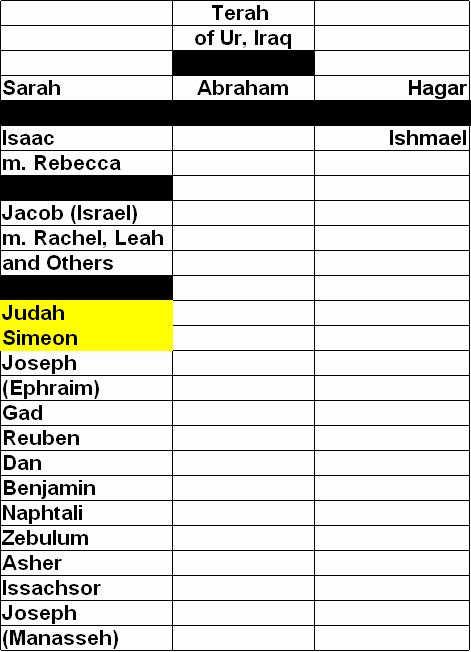
    The following explains the family relationship between the Jews and the Arabs that started about BC 1890 in Ur, Iraq, with Terah, the father of Abraham.

    The tribes of Mecca were the descendants of Ishmael, Abraham's son by Hagar, and from one of these tribes came Mohammed, the founder of Islam.

    The twelve tribes of Israel were the descendants of Isaac, Abraham's son by Sarah, and from Judah -- one of the two remaining of the twelve tribes -- came Jesus, the founder of Christianity.


    Isaac married Rebecca; their son Jacob (Israel) married Rachel, Leah and others.

    From Jacob (Israel)  and his wives came the the twelve tribes, of which only Judah and Simeon are known,

    The ten lost tribes of Isreal are Joseph, Ephraim, Gad, Reuben, Dan, Benjamin, Naphtali, Zebulum, Asher, Issachsor, Manassah.

    Labels: , , , , , , , , , , , , , , , , , ,

    Copyright 2006-2014 Early Civilizations

    jews and moslems are family!

    In that both Jews and Moslems acknowledge Abraham as their founding ancestor, they are essentially of the same Semitic family and inherited not only Abraham's belief in one God but also the Covenant he made with Him.

    Abraham's year of birth is unknown, but is likely to be around 1860 BC. What we do know about Abraham is that he was born in Ur, southern Iraq - during the Sumeric civilization (3500-1700 BC), from which the Babylonian civilization emerged (1500-538 BC) - and was the son of Terah, a wealthy trader in religious idols.

    At an early age, Abraham developed a belief in one God - a belief that was totally alien to his times - and he also had a bad temper. Both his 'strange' belief, his visions and his erratic temper were probably indicative of a mental disorder, and he was therefore lucky to have a loving family to protect him.

    When Abraham became so intolerant of the polytheistic idols in his father's shop that he smashes them in a fit of anger, he raised the wrath of the king who tries to have Abraham burned alive for his disbelief in idolatry.

    Abraham's father, Terah, protects his son by quickly moving the whole family - including his nephew, Lot, and Sarah, Abraham's wife - to Haran in Canaan.

    In Haran, about ten years later, Abraham is commanded by his God to leave his father's house and is promised that his descendants will be numerous. He then travels to Egypt and back, settles in Hebron, grows rich and distinguishes himself as a warrior king - but for all this time he failed to father any children.


    Childless in his old age, and feeling a wretch of a man because of it, Abraham has many visions and conversations with God and finally has a dream where God appears as a smoking torch and commands him to inscribe in blood the sign of the Covenant on his body. The thought of an old man circumcising himself - without anesthetic or surgical instruments - is frightening; but such was Abraham's belief that in doing so, God's promise about many descendants would come to pass.

    The custom of circumcision, then, originated with this Covenant - this plea bargain with God that Abraham made in order to father children.


    In pity at her husband's despair, and what he had done to himself, Sarah offers her Egyptian slave, Hagar, to Abraham for sex - in the hope that a child would ensue. In c.1800 BC, when Abraham was about 60, a son, Ishmael, was born to Abraham and Hagar at Hebron.

    Four years later, c.1796 BC, Sarah herself gave birth to the second son of Abraham, Isaac. The Bible states Sarah's age - like Abraham's - as quite ancient; but common sense dictates that in 1796 BC she was at most 50 and Abraham about 64.

    Abraham was then 'commanded by God' to take his favorite son to Mt Moriah for sacrifice. Actually, the practice of sacrificing children was common at the time and what Abraham was doing was following a pagan custom.

    The Moslems say that Abraham took Ishmael, but the Jews insist it was Isaac, but whichever boy it was, the sacrifice was stayed by God. The Bible claims that God was testing Abraham's faith, but common sense dictates that the poor old man couldn't bear to part with a son he had waited so long for.

    Actually, it is more likely that Abraham chose his firstborn, Ishmael, for the aborted sacrifice because shortly afterwards a jealous Sarah had Hagar and Ishmael banished.


    Ishmael and his slave mother, Hagar, settled in Mecca where Abraham often visited to see his firstborn son. Hagar believed that Ishmael would sire a great nation through 12 sons - the 12 Arab tribes; but the Jews believe that the Covenant only flowed through Isaac and Sarah's lineage.

    The Moslems claim that Ishmael was circumcised - took the blood Covenant - and therefore disenfranchised the Jews. Furthermore, the Moslems claim that God chooses his people on commitment and surrender - not lineage - and that by worshipping the golden calf in the Exodus from Egypt, the Jews proved themselves unworthy of being the Chosen People.


    Mohammed, born 570 AD, the founder of Islam (670 AD), claims to have descended from Ishmael; and Judah, born c.1740 BC, the founder of Judaism (c. 1700 BC), claims to have descended from Isaac through Jacob. Jacob, who changed his name to Israel, was the founder of the nation of Israel and was Isaac and Rebecca's second son. With his two wives and two concubines Jacob fathered 12 sons who, in turn, fathered the 12 tribes of Israel.

    In that part of the world in ancient times - and in some parts, even today - it was the custom for rich men to have many wives and even more concubines and scores if not hundreds of children. Furthermore, in that these were wandering tribes - traveling all over the Middle Eastern lands - their wives and concubines were from all lands, and their children were thus of mixed race.

    Joseph, for instance, was the son of Jacob's 2nd wife, Rachel, and because he was Jacob's favorite he was sold to slave traders by the 6 jealous sons of the 1st wife, Leah, and ended up in Egypt where he gained fame as a dream-reader and became the Pharaoh's 2nd in command. When famine hit Israel, the 6 jealous half-brothers begged for help from Joseph, and he magnanimously forgave them and allowed the Israelites safe passage to Egypt.

    When Seti became King of Egypt in 1304 BC - 43 years after Tutankhamen, 73 years after Akhenaton - he feared the Israelites were outnumbering the Egyptians and ordered all newborn male Israelites to be thrown into the Nile. One child, Moses, was saved and raised by the Pharaoh's daughter, but when Moses grows up and kills an Egyptian for mistreating the Israelites, he flees Egypt but returns when God tells him to lead the Children of Israel out of Egypt. The Pharaoh, Seti's son Rameses II (1290BC - 1224 BC), refuses to free the Israelites, God sends 10 plagues, including the death of every first born Egyptian, including the Pharaoh's, and finally he lets them go, showering them with golden gifts, but changes his mind, goes after Moses, and God saves the Israelites by 'parting' the Red Sea for them to pass through safely.

    In that the ancient Israelites spent time in Egypt and lands now known as Iraq, Syria, Lebanon, Palestine and Saudi Arabia - and freely intermarried or bred with the local people - the likelihood of everyone in the Middle East being closely related to the Jews is significantly higher than it is elsewhere.

    The Moslems and the Jews are indeed not only of the same race but also of the same ancestral families, and as such there is as much bad blood between them now as there was between the families of the Patriarchs.

    Labels: , , , , , , , , , , , , , , , , ,

    Copyright 2006-2014 Early Civilizations