October 09, 2007

Muhammad and Islam

As a likely descendant of Abraham through Ishmael and his Egyptian slave mother, Hagar -- both banished to Mecca by Abraham's jealous wife, Sarah -- Muhammad (c. 570 – 632) was an Arab political and military leader who set himself up as God's final prophet and his followers, under the caliphate, as the world's final rulers.

Initially, Muhammad was neither a Jew nor a Christian. As a youth, he worshipped all of the 360 Pagan gods in the Kabah in Mecca owned and operated by his Quraish tribe. He was just one of thousands of young Arab men from wealthy families who were set adrift as the former Roman provinces, now under the control of Christian bishops, became embroiled in one theological argument after another, leaving a political vacuum.

At some point in his life Muhammad was converted to the concept of monotheism by the Christians, but being a proud Arab he saw more political gain in reforming his native pagan religion than adopting a foreign religion like Christianity. He took the top pagan god of the Kabah in Mecca (called Hubal and/or Allah), chose it to be his new monotheistic god and set about converting all the Arab people to monotheism.

Mohammad's followers claim that Islam was not a new religion but a restoration of the primordial and supreme religion of mankind professed by Adam. To them, Abraham, Moses, Jesus and all of the Hebrew prophets were prophets of Islam, but their message and their texts had become corrupted. All children, according to Islam, are born Muslims, but are converted to another faith by their parents.

In that converts were won by using an existing Pagan deity as the god of Islam -- and Mecca, the home of that deity as the holy place of Islam -- it can be argued that Muslims are not worshipping the same god as the Hebrew prophets and in that respect it was a new religion.

However, Islam -- meaning submission, the total surrender of oneself to God -- is far more like Judaism than Christianity in that it rejects the notion of God begetting or being begotten. Both Jews and Muslims (one who submits to God) totally reject the Christian doctrine of the Trinity -- the father, the son and the holy ghost -- which they compare to polytheism.

By uniting the Arabs with Islam, Muhammad believed that the Arabs could easily conquer all of the former Roman provinces that had been torn asunder by Christian theological arguments. He was a political and military strategist who used religion to further his aims, a fact understood too well by his Quraish tribe in Mecca. For 13 years Muhammad preached to the people of Mecca, imploring them to abandon polytheism, until persecution by the leading Meccan authorities caused him to flee to Medina in 622. Called Hegira, this flight dates the birth of Islam.

In Medina, Muhammad established his political and religious authority by appealing to the many disgruntled, alienated and persecuted people of all faiths from the old Roman provinces who were happy to accept Allah as their god and Mohammad as their leader. He fought two battles against Meccan forces -- the victorious Battle of Badr in 624 and the inconclusive Battle of Uhud in 625 -- and conflict with Jewish clans in Medina led to their exile, enslavement or death.

Finally, by bringing surrounding desert tribes under his control, the Meccan trade routes were cut off and by 629 Muhammad was victorious in the nearly bloodless Conquest of Mecca.

In the last ten years of his life, Muhammad organized 65 military campaigns and personally led 27 of them. The more power he attained, the less the excuse needed to go to battle, until finally he began attacking tribes merely because they were not part of his growing empire. By the time of his death in 632 Muhammad ruled over the Arabian peninsula and left instructions for his followers to press the Jihad against the Hindus, Christians, Jews, Zoroastrians (Persians) and Buddhists.

Beginning at the age of 40 and continuing for the last 23 years of his life Muhammad reported receiving revelations from God. The content of these revelations was memorized and recorded by his companions. Known as the Qur'an (Koran), these revelations, like those of Jesus recorded in the Bible, were undoubtedly embellished and edited according to the political climate and particular aspirations of later Islamic leaders.

In Muslim tradition, Muhammad is believed to be the last and the greatest in a series of prophets, a man closest to perfection and the possessor of all virtues. Muhammad's life is called the Sunnah (the trodden path) and all Muslims are encouraged to emulate his actions in their daily lives.

Muhammad's first wife -- Khadija, a woman much older than himself -- died a few years before he fled to Medina and, at the age of 49, he was betrothed to Aisha, aged six, the daughter of his closest friend, Abu Bakr. Three years later, following an illness that hastened Aisha's first menstrual cycle, he then formally married and sexually consummated his marriage with her. This was in accordance with acceptable custom at that time, Mary the mother of Jesus being not much older than 9.

Aisha was extremely jealous of Muhammad's other wives -- he had 11, despite God telling him that a man may only have four wives -- and she often resorted to conspiring with the other wives, lying and deceiving, in order to keep Muhammad's attention.

After Muhammad’s death, his most faithful followers and even his own family immediately turned on each other -- creating the Shia and Sunni factions -- making one wonder whether they were acting piously by following the Sunnah (emulating Muhammad’s actions) or behaving lawlessly without the slightest regard for the religion they professed to follow.
Aisha was a ringleader in the first Muslim civil war -- the first time Muslims took arms up against other Muslims. In the Battle of the Camel, between Aisha (later the Sunni faction) and Ali ibn Abi Talib -- the cousin and son-in-law of Muhammad (later the Shia faction) -- thousands of Muslims were killed fighting against each other.

Aisha's side lost, and she was put under house arrest by Ali. At the age of 18, Aisha's life was thus virtually over because whereas a man may marry up to four wives if he believes he can treat them equally, a woman may marry one man only. And, as the wife of the Prophet, she was his in this world and the next.

Muhammad’s own daughter, Fatima -- married to Ali ibn Abi Talib, Muhammad’s cousin -- died of stress from persecution within three months of her father's death, and Ali was later assassinated. Their son (Muhammad’s grandson) was killed in battle with the Sunni faction. This slaughter was surely not what Muhammad would have wanted, but without annointing a successor maybe it is exactly what he intended in order to ensure that the next leader was as strong and ruthless as himself.

There were four Caliphs (leaders) in the first twenty-five years. Three of the four were murdered. The third Caliph was murdered by the son of the first. The fourth Caliph was murdered by the fifth, who left a 100-year dynasty that was ended in a gruesome, widespread bloodbath by descendants of Muhammad’s uncle.

Despite it's early horrors -- and four centuries of Muslim armies invading many lands, plundering them and forcing the survivors to either convert or pay tribute at the point of a sword -- the Arabic civilization under the Caliphate was one of the most advanced in the world during the Middle Ages. This was made possible by the monolithic Arab empire giving way to a more religiously homogenized Muslim world respecting the caliph's titular authority yet bringing new legal, philosophical, and religious ideas to Islamic scholarship.

Had Islamic philosophers such as Ibn Sina (Avicenna) and Al-Farabi been allowed to incorporate Greek principles into Islamic theology, relations between the Islamic world and the newly forming western civilization may have taken a less bloody path.


This article first appeared as Islam, a restoration of Abraham's ideal?

Labels: , , , , , , , , , , , , , , , , , , ,

Copyright 2006-2014 Early Civilizations

arabic civilization under the muslim caliphate

As a likely descendant of Abraham through Ishmael and his Egyptian slave mother, Hagar -- both banished to Mecca by Abraham's jealous wife, Sarah -- Muhammad (c. 570 – 632) was an Arab political and military leader who set himself up as God's final prophet and his followers, under the caliphate, as the world's final rulers.

Initially, Muhammad was neither a Jew nor a Christian. As a youth, he worshipped all of the 360 Pagan gods in the Kabah in Mecca owned and operated by his Quraish tribe. He was just one of thousands of young Arab men from wealthy families who were set adrift as the former Roman provinces, now under the control of Christian bishops, became embroiled in one theological argument after another, leaving a political vacuum.

At some point in his life Muhammad was converted to the concept of monotheism by the Christians, but being a proud Arab he saw more political gain in reforming his native pagan religion than adopting a foreign religion like Christianity. He took the top pagan god of the Kabah in Mecca (called Hubal and/or Allah), chose it to be his new monotheistic god and set about converting all the Arab people to monotheism.

Mohammad's followers claim that Islam was not a new religion but a restoration of the primordial and supreme religion of mankind professed by Adam. To them, Abraham, Moses, Jesus and all of the Hebrew prophets were prophets of Islam, but their message and their texts had become corrupted. All children, according to Islam, are born Muslims, but are converted to another faith by their parents.

In that converts were won by using an existing Pagan deity as the god of Islam -- and Mecca, the home of that deity as the holy place of Islam -- it can be argued that Muslims are not worshipping the same god as the Hebrew prophets and in that respect it was a new religion.

However, Islam -- meaning submission, the total surrender of oneself to God -- is far more like Judaism than Christianity in that it rejects the notion of God begetting or being begotten. Both Jews and Muslims (one who submits to God) totally reject the Christian doctrine of the Trinity -- the father, the son and the holy ghost -- which they compare to polytheism.

By uniting the Arabs with Islam, Muhammad believed that the Arabs could easily conquer all of the former Roman provinces that had been torn asunder by Christian theological arguments. He was a political and military strategist who used religion to further his aims, a fact understood too well by his Quraish tribe in Mecca. For 13 years Muhammad preached to the people of Mecca, imploring them to abandon polytheism, until persecution by the leading Meccan authorities caused him to flee to Medina in 622. Called Hegira, this flight dates the birth of Islam.

In Medina, Muhammad established his political and religious authority by appealing to the many disgruntled, alienated and persecuted people of all faiths from the old Roman provinces who were happy to accept Allah as their god and Mohammad as their leader. He fought two battles against Meccan forces -- the victorious Battle of Badr in 624 and the inconclusive Battle of Uhud in 625 -- and conflict with Jewish clans in Medina led to their exile, enslavement or death.

Finally, by bringing surrounding desert tribes under his control, the Meccan trade routes were cut off and by 629 Muhammad was victorious in the nearly bloodless Conquest of Mecca.

In the last ten years of his life, Muhammad organized 65 military campaigns and personally led 27 of them. The more power he attained, the less the excuse needed to go to battle, until finally he began attacking tribes merely because they were not part of his growing empire. By the time of his death in 632 Muhammad ruled over the Arabian peninsula and left instructions for his followers to press the Jihad against the Hindus, Christians, Jews, Zoroastrians (Persians) and Buddhists.

Beginning at the age of 40 and continuing for the last 23 years of his life Muhammad reported receiving revelations from God. The content of these revelations was memorized and recorded by his companions. Known as the Qur'an (Koran), these revelations, like those of Jesus recorded in the Bible, were undoubtedly embellished and edited according to the political climate and particular aspirations of later Islamic leaders.

In Muslim tradition, Muhammad is believed to be the last and the greatest in a series of prophets, a man closest to perfection and the possessor of all virtues. Muhammad's life is called the Sunnah (the trodden path) and all Muslims are encouraged to emulate his actions in their daily lives.

Muhammad's first wife -- Khadija, a woman much older than himself -- died a few years before he fled to Medina and, at the age of 49, he was betrothed to Aisha, aged six, the daughter of his closest friend, Abu Bakr. Three years later, following an illness that hastened Aisha's first menstrual cycle, he then formally married and sexually consummated his marriage with her. This was in accordance with acceptable custom at that time, Mary the mother of Jesus being not much older than 9.

Aisha was extremely jealous of Muhammad's other wives -- he had 11, despite God telling him that a man may only have four wives -- and she often resorted to conspiring with the other wives, lying and deceiving, in order to keep Muhammad's attention.

After Muhammad’s death, his most faithful followers and even his own family immediately turned on each other -- creating the Shia and Sunni factions -- making one wonder whether they were acting piously by following the Sunnah (emulating Muhammad’s actions) or behaving lawlessly without the slightest regard for the religion they professed to follow.

Aisha was a ringleader in the first Muslim civil war -- the first time Muslims took arms up against other Muslims. In the Battle of the Camel, between Aisha (later the Sunni faction) and Ali ibn Abi Talib -- the cousin and son-in-law of Muhammad (later the Shia faction) -- thousands of Muslims were killed fighting against each other.

Aisha's side lost, and she was put under house arrest by Ali. At the age of 18, Aisha's life was thus virtually over because whereas a man may marry up to four wives if he believes he can treat them equally, a woman may marry one man only. And, as the wife of the Prophet, she was his in this world and the next.

Muhammad’s own daughter, Fatima -- married to Ali ibn Abi Talib, Muhammad’s cousin -- died of stress from persecution within three months of her father's death, and Ali was later assassinated. Their son (Muhammad’s grandson) was killed in battle with the Sunni faction. This slaughter was surely not what Muhammad would have wanted, but without annointing a successor maybe it is exactly what he intended in order to ensure that the next leader was as strong and ruthless as himself.

There were four Caliphs (leaders) in the first twenty-five years. Three of the four were murdered. The third Caliph was murdered by the son of the first. The fourth Caliph was murdered by the fifth, who left a 100-year dynasty that was ended in a gruesome, widespread bloodbath by descendants of Muhammad’s uncle.

Despite it's early horrors -- and four centuries of Muslim armies invading many lands, plundering them and forcing the survivors to either convert or pay tribute at the point of a sword -- the Arabic civilization under the Caliphate was one of the most advanced in the world during the Middle Ages. This was made possible by the monolithic Arab empire giving way to a more religiously homogenized Muslim world respecting the caliph's titular authority yet bringing new legal, philosophical, and religious ideas to Islamic scholarship.

Had Islamic philosophers such as Ibn Sina (Avicenna) and Al-Farabi been allowed to incorporate Greek principles into Islamic theology, relations between the Islamic world and the newly forming western civilization may have taken a less bloody path.


This article first appeared as Islam, a restoration of Abraham's ideal?

Labels: , , , , , , , , , , , , , , , , , , ,

Copyright 2006-2014 Early Civilizations

Islam, a restoration of Abraham's ideal?

As a likely descendant of Abraham through Ishmael and his Egyptian slave mother, Hagar -- both banished to Mecca by Abraham's jealous wife, Sarah -- Muhammad (c. 570 – 632) was an Arab political and military leader who set himself up as God's final prophet and his followers, under the caliphate, as the world's final rulers.

Initially, Muhammad was neither a Jew nor a Christian. As a youth, he worshipped all of the 360 Pagan gods in the Kabah in Mecca owned and operated by his Quraish tribe. He was just one of thousands of young Arab men from wealthy families who were set adrift as the former Roman provinces, now under the control of Christian bishops, became embroiled in one theological argument after another, leaving a political vacuum.

At some point in his life Muhammad was converted to the concept of monotheism by the Christians, but being a proud Arab he saw more political gain in reforming his native pagan religion than adopting a foreign religion like Christianity. He took the top pagan god of the Kabah in Mecca (called Hubal and/or Allah), chose it to be his new monotheistic god and set about converting all the Arab people to monotheism.

Mohammad's followers claim that Islam was not a new religion but a restoration of the primordial and supreme religion of mankind professed by Adam. To them, Abraham, Moses, Jesus and all of the Hebrew prophets were prophets of Islam, but their message and their texts had become corrupted. All children, according to Islam, are born Muslims, but are converted to another faith by their parents.

In that converts were won by using an existing Pagan deity as the god of Islam -- and Mecca, the home of that deity as the holy place of Islam -- it can be argued that Muslims are not worshipping the same god as the Hebrew prophets and in that respect it was a new religion.

However, Islam -- meaning submission, the total surrender of oneself to God -- is far more like Judaism than Christianity in that it rejects the notion of God begetting or being begotten. Both Jews and Muslims (one who submits to God) totally reject the Christian doctrine of the Trinity -- the father, the son and the holy ghost -- which they compare to polytheism.

By uniting the Arabs with Islam, Muhammad believed that the Arabs could easily conquer all of the former Roman provinces that had been torn asunder by Christian theological arguments. He was a political and military strategist who used religion to further his aims, a fact understood too well by his Quraish tribe in Mecca. For 13 years Muhammad preached to the people of Mecca, imploring them to abandon polytheism, until persecution by the leading Meccan authorities caused him to flee to Medina in 622. Called Hegira, this flight dates the birth of Islam.

In Medina, Muhammad established his political and religious authority by appealing to the many disgruntled, alienated and persecuted people of all faiths from the old Roman provinces who were happy to accept Allah as their god and Mohammad as their leader. He fought two battles against Meccan forces -- the victorious Battle of Badr in 624 and the inconclusive Battle of Uhud in 625 -- and conflict with Jewish clans in Medina led to their exile, enslavement or death.

Finally, by bringing surrounding desert tribes under his control, the Meccan trade routes were cut off and by 629 Muhammad was victorious in the nearly bloodless Conquest of Mecca.

In the last ten years of his life, Muhammad organized 65 military campaigns and personally led 27 of them. The more power he attained, the less the excuse needed to go to battle, until finally he began attacking tribes merely because they were not part of his growing empire. By the time of his death in 632 Muhammad ruled over the Arabian peninsula and left instructions for his followers to press the Jihad against the Hindus, Christians, Jews, Zoroastrians (Persians) and Buddhists.

Beginning at the age of 40 and continuing for the last 23 years of his life Muhammad reported receiving revelations from God. The content of these revelations was memorized and recorded by his companions. Known as the Qur'an (Koran), these revelations, like those of Jesus recorded in the Bible, were undoubtedly embellished and edited according to the political climate and particular aspirations of later Islamic leaders.

In Muslim tradition, Muhammad is believed to be the last and the greatest in a series of prophets, a man closest to perfection and the possessor of all virtues. Muhammad's life is called the Sunnah (the trodden path) and all Muslims are encouraged to emulate his actions in their daily lives.

Muhammad's first wife -- Khadija, a woman much older than himself -- died a few years before he fled to Medina and, at the age of 49, he was betrothed to Aisha, aged six, the daughter of his closest friend, Abu Bakr. Three years later, following an illness that hastened Aisha's first menstrual cycle, he then formally married and sexually consummated his marriage with her. This was in accordance with acceptable custom at that time, Mary the mother of Jesus being not much older than 9.

Aisha was extremely jealous of Muhammad's other wives -- he had 11, despite God telling him that a man may only have four wives -- and she often resorted to conspiring with the other wives, lying and deceiving, in order to keep Muhammad's attention.

After Muhammad’s death, his most faithful followers and even his own family immediately turned on each other -- creating the Shia and Sunni factions -- making one wonder whether they were acting piously by following the Sunnah (emulating Muhammad’s actions) or behaving lawlessly without the slightest regard for the religion they professed to follow.
Aisha was a ringleader in the first Muslim civil war -- the first time Muslims took arms up against other Muslims. In the Battle of the Camel, between Aisha (later the Sunni faction) and Ali ibn Abi Talib -- the cousin and son-in-law of Muhammad (later the Shia faction) -- thousands of Muslims were killed fighting against each other.

Aisha's side lost, and she was put under house arrest by Ali. At the age of 18, Aisha's life was thus virtually over because whereas a man may marry up to four wives if he believes he can treat them equally, a woman may marry one man only. And, as the wife of the Prophet, she was his in this world and the next.

Muhammad’s own daughter, Fatima -- married to Ali ibn Abi Talib, Muhammad’s cousin -- died of stress from persecution within three months of her father's death, and Ali was later assassinated. Their son (Muhammad’s grandson) was killed in battle with the Sunni faction. This slaughter was surely not what Muhammad would have wanted, but without annointing a successor maybe it is exactly what he intended in order to ensure that the next leader was as strong and ruthless as himself.

There were four Caliphs (leaders) in the first twenty-five years. Three of the four were murdered. The third Caliph was murdered by the son of the first. The fourth Caliph was murdered by the fifth, who left a 100-year dynasty that was ended in a gruesome, widespread bloodbath by descendants of Muhammad’s uncle.

Despite it's early horrors -- and four centuries of Muslim armies invading many lands, plundering them and forcing the survivors to either convert or pay tribute at the point of a sword -- the Arabic civilization under the Caliphate was one of the most advanced in the world during the Middle Ages. This was made possible by the monolithic Arab empire giving way to a more religiously homogenized Muslim world respecting the caliph's titular authority yet bringing new legal, philosophical, and religious ideas to Islamic scholarship.

Had Islamic philosophers such as Ibn Sina (Avicenna) and Al-Farabi been allowed to incorporate Greek principles into Islamic theology, relations between the Islamic world and the newly forming western civilization may have taken a less bloody path.

Labels: , , , , , , , , , , , , , , , , , , ,

Copyright 2006-2014 Early Civilizations

March 11, 2007

710-729 Moslems Conquer Spain, Bede Suggests AD Calendar


This twenty year period saw the start of the Moslem Arab conquest of Visigoth Spain during which the Christian nobles of Spain rapidly converted to Islam and many Spanish scholars fled to other parts of Christian Europe, enriching their new countries with the texts they brought with them.

When Spain was being conquered and converted to Islam, the Eastern Emperor Justinian II and the Pope in Rome, Constantine -- a Syrian as was the former pope -- met at Nicomedia in 711. Emperor Justinian dutifully kissed Constantine's feet and took communion -- only to be murdered soon after, as was his successor.

The new Emperor Leo III (717-741) and the new Pope Gregory II (715-731) were not so cosy. Leo III imposed enormous taxes on Italy and ordered Gregory II to break all images of worship. Pope Gregory II was having trouble at home with the Lombards and Emperor Leo III's impositions acted to draw the Lombards and the pope into an alliance against imperial rule.

Also, when Spain was being conquered and converted to Islam, the Venerable Bede -- a monk living on the banks of the River Tyne -- wrote "On the Reckoning of Time" in 725 arguing that the Church should not rely on the pagan system of dating according to the accession dates of the Roman Emperors.

Instead, he suggested a new way of dating by the birth of Christ -AD anno domini.

When those entrusted and empowered to rule over us are busy kissing feet, taking communion, breaking images and raising enormous taxes to pay for their opulent lifestyles is it no wonder that the Arabs were able to conquer and convert Spain to Islam so easily.


Labels: , , , , , , , , ,

Copyright 2006-2014 Early Civilizations

670-689 Rome Argues Theology While Islam Advances


In this twenty year period the ruling powers in Rome and Constantinople sat around arguing about theology while the Islamic tide advanced throughout the east, the Lombards strengthened their position in Europe and plague ravaged England in 685.

This time, theological controversy was Monothelitism -- the belief that Christ did not possess simultaneously a divine will and a human will, but only one that he exercised through both his divine and human natures -- first put forward by Pope Honorius I in 625.

Emperor Constantine IV wanted to ban Monothelitism -- as did the Pope Agatho (678-681) -- and it was duly put to rest at the Council of Constantinople in 680.

By 680, the empire was forced to recognize the Lombard Kingdom in Italy, and the conversion of the Lombards to Catholicism made their rule more acceptable to the ruling class (represented by the bishop of Rome)

Another ramification of theological oblivion of this period that allowed the Islamic advance was that Rome gained supremacy over Constantinople. Only four of the next sixteen popes would come from Rome, the rest would come from eastern areas lost to Islam.

Also, the election of popes from Leo II onwards came to be subject to the emperor's approval rather than that of Constantinople

Labels: , , , , ,

Copyright 2006-2014 Early Civilizations

December 11, 2006

abraham's descendants

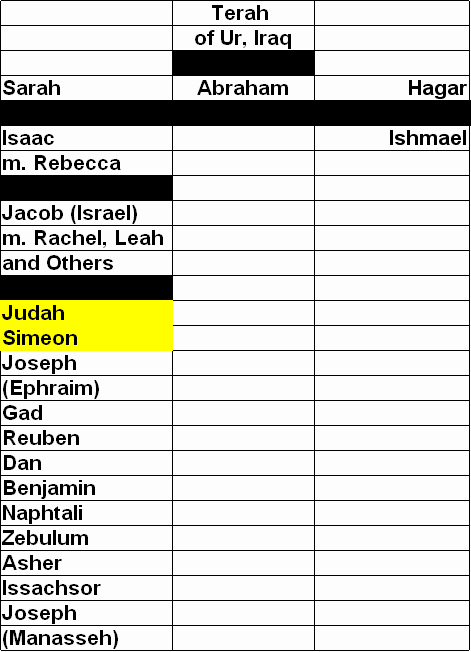
The following explains the family relationship between the Jews and the Arabs that started about BC 1890 in Ur, Iraq, with Terah, the father of Abraham.

The tribes of Mecca were the descendants of Ishmael, Abraham's son by Hagar, and from one of these tribes came Mohammed, the founder of Islam.

The twelve tribes of Israel were the descendants of Isaac, Abraham's son by Sarah, and from Judah -- one of the two remaining of the twelve tribes -- came Jesus, the founder of Christianity.


Isaac married Rebecca; their son Jacob (Israel) married Rachel, Leah and others.

From Jacob (Israel)  and his wives came the the twelve tribes, of which only Judah and Simeon are known,

The ten lost tribes of Isreal are Joseph, Ephraim, Gad, Reuben, Dan, Benjamin, Naphtali, Zebulum, Asher, Issachsor, Manassah.

Labels: , , , , , , , , , , , , , , , , , ,

Copyright 2006-2014 Early Civilizations

jews and moslems are family!

In that both Jews and Moslems acknowledge Abraham as their founding ancestor, they are essentially of the same Semitic family and inherited not only Abraham's belief in one God but also the Covenant he made with Him.

Abraham's year of birth is unknown, but is likely to be around 1860 BC. What we do know about Abraham is that he was born in Ur, southern Iraq - during the Sumeric civilization (3500-1700 BC), from which the Babylonian civilization emerged (1500-538 BC) - and was the son of Terah, a wealthy trader in religious idols.

At an early age, Abraham developed a belief in one God - a belief that was totally alien to his times - and he also had a bad temper. Both his 'strange' belief, his visions and his erratic temper were probably indicative of a mental disorder, and he was therefore lucky to have a loving family to protect him.

When Abraham became so intolerant of the polytheistic idols in his father's shop that he smashes them in a fit of anger, he raised the wrath of the king who tries to have Abraham burned alive for his disbelief in idolatry.

Abraham's father, Terah, protects his son by quickly moving the whole family - including his nephew, Lot, and Sarah, Abraham's wife - to Haran in Canaan.

In Haran, about ten years later, Abraham is commanded by his God to leave his father's house and is promised that his descendants will be numerous. He then travels to Egypt and back, settles in Hebron, grows rich and distinguishes himself as a warrior king - but for all this time he failed to father any children.


Childless in his old age, and feeling a wretch of a man because of it, Abraham has many visions and conversations with God and finally has a dream where God appears as a smoking torch and commands him to inscribe in blood the sign of the Covenant on his body. The thought of an old man circumcising himself - without anesthetic or surgical instruments - is frightening; but such was Abraham's belief that in doing so, God's promise about many descendants would come to pass.

The custom of circumcision, then, originated with this Covenant - this plea bargain with God that Abraham made in order to father children.


In pity at her husband's despair, and what he had done to himself, Sarah offers her Egyptian slave, Hagar, to Abraham for sex - in the hope that a child would ensue. In c.1800 BC, when Abraham was about 60, a son, Ishmael, was born to Abraham and Hagar at Hebron.

Four years later, c.1796 BC, Sarah herself gave birth to the second son of Abraham, Isaac. The Bible states Sarah's age - like Abraham's - as quite ancient; but common sense dictates that in 1796 BC she was at most 50 and Abraham about 64.

Abraham was then 'commanded by God' to take his favorite son to Mt Moriah for sacrifice. Actually, the practice of sacrificing children was common at the time and what Abraham was doing was following a pagan custom.

The Moslems say that Abraham took Ishmael, but the Jews insist it was Isaac, but whichever boy it was, the sacrifice was stayed by God. The Bible claims that God was testing Abraham's faith, but common sense dictates that the poor old man couldn't bear to part with a son he had waited so long for.

Actually, it is more likely that Abraham chose his firstborn, Ishmael, for the aborted sacrifice because shortly afterwards a jealous Sarah had Hagar and Ishmael banished.


Ishmael and his slave mother, Hagar, settled in Mecca where Abraham often visited to see his firstborn son. Hagar believed that Ishmael would sire a great nation through 12 sons - the 12 Arab tribes; but the Jews believe that the Covenant only flowed through Isaac and Sarah's lineage.

The Moslems claim that Ishmael was circumcised - took the blood Covenant - and therefore disenfranchised the Jews. Furthermore, the Moslems claim that God chooses his people on commitment and surrender - not lineage - and that by worshipping the golden calf in the Exodus from Egypt, the Jews proved themselves unworthy of being the Chosen People.


Mohammed, born 570 AD, the founder of Islam (670 AD), claims to have descended from Ishmael; and Judah, born c.1740 BC, the founder of Judaism (c. 1700 BC), claims to have descended from Isaac through Jacob. Jacob, who changed his name to Israel, was the founder of the nation of Israel and was Isaac and Rebecca's second son. With his two wives and two concubines Jacob fathered 12 sons who, in turn, fathered the 12 tribes of Israel.

In that part of the world in ancient times - and in some parts, even today - it was the custom for rich men to have many wives and even more concubines and scores if not hundreds of children. Furthermore, in that these were wandering tribes - traveling all over the Middle Eastern lands - their wives and concubines were from all lands, and their children were thus of mixed race.

Joseph, for instance, was the son of Jacob's 2nd wife, Rachel, and because he was Jacob's favorite he was sold to slave traders by the 6 jealous sons of the 1st wife, Leah, and ended up in Egypt where he gained fame as a dream-reader and became the Pharaoh's 2nd in command. When famine hit Israel, the 6 jealous half-brothers begged for help from Joseph, and he magnanimously forgave them and allowed the Israelites safe passage to Egypt.

When Seti became King of Egypt in 1304 BC - 43 years after Tutankhamen, 73 years after Akhenaton - he feared the Israelites were outnumbering the Egyptians and ordered all newborn male Israelites to be thrown into the Nile. One child, Moses, was saved and raised by the Pharaoh's daughter, but when Moses grows up and kills an Egyptian for mistreating the Israelites, he flees Egypt but returns when God tells him to lead the Children of Israel out of Egypt. The Pharaoh, Seti's son Rameses II (1290BC - 1224 BC), refuses to free the Israelites, God sends 10 plagues, including the death of every first born Egyptian, including the Pharaoh's, and finally he lets them go, showering them with golden gifts, but changes his mind, goes after Moses, and God saves the Israelites by 'parting' the Red Sea for them to pass through safely.

In that the ancient Israelites spent time in Egypt and lands now known as Iraq, Syria, Lebanon, Palestine and Saudi Arabia - and freely intermarried or bred with the local people - the likelihood of everyone in the Middle East being closely related to the Jews is significantly higher than it is elsewhere.

The Moslems and the Jews are indeed not only of the same race but also of the same ancestral families, and as such there is as much bad blood between them now as there was between the families of the Patriarchs.

Labels: , , , , , , , , , , , , , , , , ,

Copyright 2006-2014 Early Civilizations

December 09, 2006

how much do religions borrow from each other?

It is no coincidence that the basics of Judaism - and through it both Christianity and Islam - derive from Sumeric literature as well as its legal and moral codes.


Judah, born c.1740 BC (the son of Jacob, grandson of Isaac and great-grandson of Abraham), was the founder of Judaism and lived during the times of Hammurabi (the great king of Babylon in the civilization of Sumer situated in modern Iraq).

Abraham was born c. 1860 BC in Ur, in southern Iraq, to a wealthy family who had lived in that area for generations. The family was forced to flee to Haran in Canaan when Abraham aroused the king's wrath - but through the generations, the family of Abraham never lost touch with its homeland.

When the Hammurabi Code was proclaimed by the king of Babylon, Hammurabi, in 1750 BC, Judah was about 10 years old and he - and his father Jacob - cannot have been ignorant of it, or any of the many Sumeric codes of law that date back to c. 2250 BC under king Ur-Nammu.

The Hammurabi Code of 1750 BC (inscribed on a black stone pillar which is now located in the Louvre, Paris) is the best preserved and the most extensive of the Sumeric codes. It contains close to 300 laws - covering everything imaginable from military matters to minute personal matters - all of which, of course, are commanded by the gods, in this case the sun-god Shamash, and carry terrible punishments for non-compliance. Hammurabi collected the laws from Babylon's past rulers which, according to the Bible, started with Nimrod - the great-grandson of Noah of the Flood.

Substitute the many gods of the Sumerian civilization with the one God of the Israelites, Christians and Moslems, and there is a basic similarity between the Hammurabi Code and the Old Testament, Torah and Koran.

Furthermore, the story of Adam and Eve of Eden - depicted in Judaic-Christian literature - is influenced directly by the story of Enki and Ninhursag of Dimun in Sumeric literature. The biblical deluge story of Noah is also influenced by the story of Ziusudra in Sumeric literature; and the magnificent Sumeric epic of Gilgamesh and Enkidu - a homosexual love story - underlies a great deal of what the developing religions were all about.

The ideas of heaven and hell, resurrection, an 'eye for an eye' and taking care of widows and orphans - matters that concerned the later Prophets - all came from the Sumerian civilization. The Sumeric word for hell is Kur, meaning a 'foreign land', and considering that Sumer was protected from menacing neighbors by mountains and a river, it is easy to see how hell came to be related to crossing a river and meeting a terrible fate.

Basically, Judaism took everything it wanted from the Sumeric literature and laws and left the rest; Christianity took everything it wanted from Judaic literature and laws and left the rest; Islam took everything it wanted from Judaism, Christianity and the eastern religions and left the rest; and that is why - despite the unique features they added - they have so many similarities.

Furthermore, since the earliest known evidence of deity worship was a shrine found in northern Spain, in the El Juyu cave, c. 12,000 BC - 8,500 years before the commencement in c. 3,500 BC of the Sumerian civilization - who is to say how much of their religious rites, laws and creation stories the Sumerians borrowed from the European tribes migrating to warmer southern lands after the Ice Age ended?

Between the final recession of the Ice Age in 12,000 BC and establishment of the first civilization - the Egyptiac in c. 4000 BC - vast trade and migration routes had been opened up, and with the European migrants and traders came ideas that were far in advance of anything known elsewhere.

Before writing, which the Sumerians invented, everything was necessarily passed on from generation to generation orally - usually in the form of stories to make them easier to remember; and there is plenty of evidence, too, that early art forms are attempts to convey the culture and laws of those who drew them - either as adjuncts to the stories or as stand-alone truths.

Labels: , , , , , , , , , , , , , , , , , ,

Copyright 2006-2014 Early Civilizations

December 08, 2006

did islam prolong paganism in england?

Rome's grand plans for England in 597 - mass conversion to Christianity under rule of the Roman Pope - did not eventuate due to something entirely unexpected. The unexpected event was, of course, the birth in 622 of the new Moslem religion in the Middle East.

By 638, the Moslem Arabs had conquered Jerusalem and their impending conquest of Spain (achieved by 715) had so threatened Rome that many Roman priests fled to Ireland - an incredibly poor and backward country that had been thoroughly Christianized by St. Patrick 200 years before - and as a result of this Ireland, not England, became the cradle of western civilization and the safe haven for Roman Christianity.

Having been under Roman rule from 54BC to 407AD, England in 638 was a far more civilized country than Ireland. Also, as a result of invasions between 410-442 by fierce north European tribes - the Jutes, Angles and Saxons - England in 638 also had a far more polyglot ethnic mix than Ireland's Celts. England, of course, had its ancient Britons and Celts, but it now included Jutes, Angles and Saxons - most of whom, in 638, were fiercely Pagan - and after 787 it also included the Danes (who arrived on raids from north Europe and eventually settled in England).

Although Christianity eventually filtered through to England - and the knights of England made history in the Crusades against the Moslem Arabs - Christianity was not only never as strong in England as it was in Ireland but it was also never as Roman influenced as it was in Ireland. This is also true of the north European countries from whence a large part of both English ethnicity and the Protestant movement - which took hold in the 1500s, leading to the establishment of the Anglican Church in 1563 - is derived.


England did not reject Christianity, but it most certainly came to reject Roman rule of the new religion, especially the Pope's refusal to allow the English language to supplant Latin in services and literature.

The particular ethnicity of England - and its civilized state by 638 - may have mitigated against Roman Catholicism ever taking 100% control of England as it did in Ireland, but the threat to Rome of the Moslem Arabs that turned its attention away from England towards Ireland most definitely prolonged paganism in England and changed the course of English history.

Labels: , , , , , , , , , , , , , , , , , ,

Copyright 2006-2014 Early Civilizations

was arabic civilization founded on islam?

Arabic civilization is often confused with the Syriac and Iranic (later Islamic) civilizations. Both the Arabic and the Iranic (later Islamic) civilizations had roots in the Syriac civilization, but otherwise they were dissimilar.

The Syriac civilization existed from 1200 BC - 970 AD, and - contrary to what one might believe - it was not related to the ancient Sumeric civilization of Iraq that gave to the world, among other things, the invention of writing, and from which the Babylonian (predominantly Jewish) civilization emerged in 1500 BC.

Instead, the Syriac civilization was related to the same Minoan civilization that gave birth to the Hellenic civilization and as such it was more European than Middle Eastern. Arabic civilization existed from 975-1525 in Arabia, Iraq and Syria and it did not adopt Islam, universally, until 1516.


The Iranic (later Islamic) civilization commenced in 1320. It was initially centered in Iran and was related to the Syriac civilization. Unlike Arab civilization, it was based on Islam from the start.The birth of the religion of Islam is dated at 622 with Hegira - the flight of Mohammed to Medina; and although Islam later spread throughout the Middle Eastern nations it was not a distinctive feature of the Arabic civilization from the start.

At the time of the rise of western civilization in 675, neither the Arabic nor the Iranic (later Islamic) civilizations existed. It was, nevertheless, Arabic Islamic elements within the Syriac civilization that clashed with the West between 634-641 - culminating in the conquest of Jerusalem in 638 - and the clash was, of course, related to the different views of two religions, Christianity and Islam, that both owe their roots to Judaism.

Labels: , , , , , , , , , , ,

Copyright 2006-2014 Early Civilizations

did ireland save christianity?

The physical location of Ireland, as well as the easy conversion to Christianity of its Celtic Pagan population, most definitely provided Christianity with a safe haven, but it was the expansionist evangelical efforts of Pope Gregory (590-604) that prevented Christianity from dying out in Europe and remaining, if at all, as an essentially middle-eastern religion.

Historians claim that Ireland - an ethnic Celtic island at the westernmost part of Europe - is the cradle of western civilization, and Christianity is the religion upon which it was founded in 675 AD.

In that St. Patrick had Christianized Ireland from 432AD, and Rome was - and still is - the central power of Christianity in the western world, it does seem strange that Ireland, rather than Rome, is considered to be the cradle of western civilization and the savior of Christianity.

It is unclear whether it was the isolated western geographical region of Ireland, its distinctive race of white Celtic people or its devotion to Christianity that made it the historical birthplace of western civilization.

Actually, Ireland's geographic position had to be the definitive factor.

With the fall of the Roman Empire in 378AD, the European city states and the new religion of Christianity were in the throes of turmoil. Ireland was seen as being the last bastion - the last hope - for the continuation of any sort of European civilization, with or without Christianity, in the face of advancing hordes from eastern Europe, the far north and the Middle East. And, as it turned out, it was!

Here is what was happening in Europe at the time:
  • 378 - the Visigoths defeated the Romans at the Battle of Adrianople
  • 395 - the Roman Empire was divided into eastern and western parts
  • 407 - the Romans evacuated Britain
  • 410 - Rome sacked by the Visigoths
  • 410-442 The Jutes, Angles and Saxons invaded Britain
At this point, in 432AD, when all appeared to be lost in Europe, St Patrick returns to Ireland - where he had previously been enslaved - on an evangelical mission to introduce Christianity to the Pagan Celtic race and hopefully convert the population to his faith. In the following years, things got worse in Europe.
  • 450 - The Huns invade all Roman cities in the old Empire
  • 455 - Rome, itself, was sacked by the Vandals
It took Rome nearly 150 years to recover from the invasion, and while Christianity was stagnating in Rome it was thriving in the eastern lands. The magnificent church of St Sophia - which later became a mosque - was built in Constantinople in 532-537 and stands as evidence that Christianity was seen more as an eastern religion than a European one.

Fearing loss of power, in 597 Pope Gregory sent St Augustine to England. It was expected that with the widespread conversion to Christianity in England that Rome would regain control of that part of the world - if not politically then at least in the hearts and minds of the population - but the new religion of Islam intervened.

Labels: , , , , , , , , , , , , , , , , , ,

Copyright 2006-2014 Early Civilizations