October 15, 2014

Abraham's Legacy

The legacy of Abraham -- the father of the Jews, the Muslims and the Christians -- carries on in religious wars, jealous stepmothers, feuding families, interracial families, genital mutilation and even child sacrifice.

Abraham's year of birth is unknown, but is likely to be around 1860 BC. He was born in Ur, southern Iraq, to Terah, a wealthy trader in religious idols, and was married to Sarah. Prone to visions and violent outbursts, young Abraham raised the wrath of the king with his religious beliefs and Terah was forced to move the whole family to Haran in Canaan.

In Haran, about ten years later, Abraham and Sarah remained childless and with a vision about numerous descendants he left his father's house, travels to Egypt and back, settles in Hebron, grows rich and distinguishes himself as a warrior king.

Childless and feeling a wretch of a man because of it, Abraham has a vision where his God appears as a smoking torch and commands him to inscribe in blood the sign of the Covenant on his body. The thought of an old man circumcising himself - without anaesthetic or surgical instruments - is frightening; but such was Abraham's belief that in doing so, God's promise about many descendants would come to pass.

In pity at her husband's despair, and what he had done to himself, Sarah offers her black Egyptian slave, Hagar, to Abraham for sex in the hope that a child would ensue, and c.1800 BC, when Abraham was about 60, a son, Ishmael, was born to Abraham and Hagar at Hebron.

Four years later, c.1796 BC, Sarah herself gave birth to the second son of Abraham, Isaac.

Sarah had Ishmael and his mother, Hagar, banished to Mecca but her fury increased when Abraham insisted upon visiting them regularly. He showered them with gifts and raised Hagar's position in the Meccan community to such an extent that she told all and sundry that her son, Ishmael, would sire a great nation of God's people through 12 sons - the 12 Arab tribes.

The tribes of Mecca were indeed the descendants of Ishmael, Abraham's son by Hagar, and from one of these tribes came Mohammed, the founder of Islam. More well known, however -- thanks to Sarah's indoctrination process -- were the 12 tribes of Israel who descended from Isaac through Jacob and Judah, the founder of Judaism.

Basically, the bitter feud that continues today between Jews and Moslems started as a spat between two stepmothers who believed their sons were Abraham's 'favorite' and dutifully poisoned the minds of their sons who, in turn, dutifully poisoned the minds of their sons, ad infinitum.

What made Abraham's story go down in history rests solely upon his fabulous wealth. Sarah and Hagar, the two stepmothers, were more concerned about their status and their sons' inheritance than covenants with imaginary gods!

Labels: , , , , , , , , , , , , , ,

Copyright 2006-2014 Early Civilizations

November 28, 2007

Judaism: Religion or Tribal history?

In Christian tradition the Wandering Jew was condemned to a homeless existence until Judgment Day for having mocked Jesus Christ, and in botany the Wandering Jew was a name given to a trailing plant with colourful foliage -- even though its native origin was tropical America rather than the Middle East -- and as silly as these meanings are they are nevertheless apt, in a way, because before and after the Jewish tribes formed the United Kingdom of Israel c. 1050 BCE, they had both a colorful and a wandering history which is not just reflected in Judaism but forms the basis of it.

Starting with Abraham, he and his extended family had to flee to Canaan from his home in Ur, modern day Iraq, because his beliefs clashed with those of the ruling elites, and his grandson Jacob (later called Israel, the father of twelve sons/tribes) was even called a "wandering Aramaean" because he travelled back to the land of his ancestors to obtain a wife and generally led a transitory life -- as was common in those days, and still is in that part of the world. Traveling to Egypt, however, was a bad mistake for the descendants of Israel because they became enslaved and had to wait for a charismatic leader like Moses to facilitate their freedom c. 1250 BCE.

After leaving Egypt, the Israelites wandering in the desert for a generation until Joshua emerged to lead them in the invasion of Canaan, which they then took as their own.

At that time and place in history, there were several great empires -- the Egyptian, the Hittite, the Babylonian and the Assyrian (a land between the Hittite and Babylonian Empires) -- and vibrant new migrant colonies of Indo-European Sea People at Gaza, Ashdod, Ekron, Gath, and Ashkelon that became known as 'the Way of the Philistines', after the name of the principle tribe.

Constant trouble with the Philistines led the Israelites to form the United Kingdom of Israel c. 1050 BCE but by then very few of the Israelites were direct descendants of Abraham and true to the Covenant he had made with Yahweh. They were largely of Canaan ethnicity, with a mixture of Hittite, Aramaean and Egyptian, and they practised many faiths. Very much like today's multicultural nations.

By 1010 BCE King David ruled the United Kingdom of Israel and the mythology of the Israelite nation became established. This United Kingdom of Israel lasted until c. 920 BCE when Jeroboam led the revolt of the wealthy northern tribes who were economically better developed than the southern tribes, had better rainfall and agricultural systems. The united kingdom split into the Kingdom of Israel in the north, and the Kingdom of Judah in the South (which had Jerusalem as its capital and was led by Rehoboam).

The northern Kingdom of Israel became more powerful under Omri (c. 885-874 BC) who, with the support of the Phoenician city of Tyre, founded a new dynasty with its capital city at Samaria. Omri's successor, Jehu, linked through dynastic marriage with Tyre, joined other nations to fight and defeat the Assyrian Shalmaneser III at Qarqar in 853 BC. Twelve years later, with assistance from the Kingdom of Aram, he organised a coup in which his own kin, Ahab and his family, were put to death.

Because the northern Kingdom of Israel was falling under the influence of Damascus, losing all cultural and religious ties with the southern Kingdom of Judah, the Judaeans treacherously appealed to Assyria for intervention and ultimately, in 720 BC, Israel fell and became incorporated into the Assyrian empire. The capital Samaria was destroyed, the ruling elites were deported to other lands in the Assyrian empire and a new nobility was imported by the Assyrians. To avoid captivity or exile, thousands of Jews from the northern kingdom of Israel fled south to the southern kingdom of Judah and it is said that its capital city, Jerusalem, grew in population size by over 500%.

Judah itself fell to the Babylonians in 587 BCE, the Temple was destroyed and its ruling elites taken into captivity to Babylon. Another massive diaspora took place in which the Jews escaped slavery by fleeing to Egypt, Syria, Mesopotamia (Iraq) and Persia.

In 539 BCE the Babylonian Empire fell to Persia under Cyrus and he magnanimously freed the Jews and allowed them to return to Jerusalem -- which was now a Persian province. They were allowed to take with them the Temple vessels that the Babylonians had stolen, and construction of the Second Temple started.

In 331 BCE the Persian Empire fell to Alexander the Great of Greece, and all was well under Greek rule until 174-163 BCE when Antiochus IV Epiphanes attempted to Hellenize the Jews which led to the Maccabees's Rebellion, and the rise of John Hyrcanus, Ethnarch and High Priest of Jerusalem, 134-104 BCE, under whom the Jewish nation experienced a resurgence, annexing Trans-Jordan, Samaria, Galilee and Idumea and forcing the Idumeans to convert to Judaism.

By 63 BCE, Pompey conquered Jerusalem and it fell under Roman rule. In 66 BCE, the First Jewish-Roman War broke out. The entire Jewish garrison at Yodfat was massacred after a two month siege, and in 70 BCE the Romans destroyed the Second Temple. Those Jews that were not massacred -- or able to flee to Mesopotamia (Iraq) and other countries around the Mediterranean -- were taken to Rome as slaves. By 73 BCE the last Jewish resistance at the mountain fortress of Masada was crushed and 900 defenders committed suicide rather than be captured and sold into slavery.

Rabbi Yochanan ben Zakai escaped from Jerusalem and obtained permission to establish a center of Jewish learning, the Sanhedrin, in the outlying town of Yavneh. At this center, Rabbinic Judaism took root and the Sanhedrin became the supreme religious, political and judicial body for the 'wandering Jews'.

In 132 Simon bar Kokhba led a final revolt against the Romans, declaring an independent state in Israel, and was crushed by Rome. Seeking to suppress the Jewish place-names and humiliate the defeated Jews, the Romans renamed the area Palaestina (Latin for the Philistines, the traditional enemies of the Jews) and the Christians went one step further, after they had taken over Roman government, by forcibly disbanding the Sanhedrin in 425 CE and persecuting them forever after.

Like the early Christians in pagan Rome, the Jews went underground and survived -- moving from place to place to escape slavery and persecution, changing their religion to Christianity or Muslim according to whichever elite was in power, but never forgetting their tribal history, their roots and their self-appointed anointment as God's chosen people.

So accustomed had the Jews become to a wandering existence, that even the re-establishment of their homeland in the post WWII period did not attract the expected mass return. As with the earlier United Kingdom of Israel, divisions are appearing between the rich and the poor and the devout and the secular -- and the ancient turf war between the Philistines (Palestinians) and the Jews continues.

Ethnically, modern Jews are now more European than Semitic and it is odd they can lay claim to land on the basis of where their religion was born -- especially since it is based upon a tribal history that would make the Arabs more likely to be the true descendants of Abraham than they are -- but pointing this fact out to an Israeli would be far too confronting.

This article first appeared as Wandering Jews

Labels: , , , , , , , , , , , , , , , ,

Copyright 2006-2014 Early Civilizations

The United Kingdom of Israel

In Christian tradition the Wandering Jew was condemned to a homeless existence until Judgment Day for having mocked Jesus Christ, and in botany the Wandering Jew was a name given to a trailing plant with colourful foliage -- even though its native origin was tropical America rather than the Middle East -- and as silly as these meanings are they are nevertheless apt, in a way, because before and after the Jewish tribes formed the United Kingdom of Israel c. 1050 BCE, they had both a colorful and a wandering history which is not just reflected in Judaism but forms the basis of it.

Starting with Abraham, he and his extended family had to flee to Canaan from his home in Ur, modern day Iraq, because his beliefs clashed with those of the ruling elites, and his grandson Jacob (later called Israel, the father of twelve sons/tribes) was even called a "wandering Aramaean" because he travelled back to the land of his ancestors to obtain a wife and generally led a transitory life -- as was common in those days, and still is in that part of the world. Traveling to Egypt, however, was a bad mistake for the descendants of Israel because they became enslaved and had to wait for a charismatic leader like Moses to facilitate their freedom c. 1250 BCE.

After leaving Egypt, the Israelites wandering in the desert for a generation until Joshua emerged to lead them in the invasion of Canaan, which they then took as their own.

At that time and place in history, there were several great empires -- the Egyptian, the Hittite, the Babylonian and the Assyrian (a land between the Hittite and Babylonian Empires) -- and vibrant new migrant colonies of Indo-European Sea People at Gaza, Ashdod, Ekron, Gath, and Ashkelon that became known as 'the Way of the Philistines', after the name of the principle tribe.

Constant trouble with the Philistines led the Israelites to form the United Kingdom of Israel c. 1050 BCE but by then very few of the Israelites were direct descendants of Abraham and true to the Covenant he had made with Yahweh. They were largely of Canaan ethnicity, with a mixture of Hittite, Aramaean and Egyptian, and they practised many faiths. Very much like today's multicultural nations.

By 1010 BCE King David ruled the United Kingdom of Israel and the mythology of the Israelite nation became established. This United Kingdom of Israel lasted until c. 920 BCE when Jeroboam led the revolt of the wealthy northern tribes who were economically better developed than the southern tribes, had better rainfall and agricultural systems. The united kingdom split into the Kingdom of Israel in the north, and the Kingdom of Judah in the South (which had Jerusalem as its capital and was led by Rehoboam).

The northern Kingdom of Israel became more powerful under Omri (c. 885-874 BC) who, with the support of the Phoenician city of Tyre, founded a new dynasty with its capital city at Samaria. Omri's successor, Jehu, linked through dynastic marriage with Tyre, joined other nations to fight and defeat the Assyrian Shalmaneser III at Qarqar in 853 BC. Twelve years later, with assistance from the Kingdom of Aram, he organised a coup in which his own kin, Ahab and his family, were put to death.

Because the northern Kingdom of Israel was falling under the influence of Damascus, losing all cultural and religious ties with the southern Kingdom of Judah, the Judaeans treacherously appealed to Assyria for intervention and ultimately, in 720 BC, Israel fell and became incorporated into the Assyrian empire. The capital Samaria was destroyed, the ruling elites were deported to other lands in the Assyrian empire and a new nobility was imported by the Assyrians. To avoid captivity or exile, thousands of Jews from the northern kingdom of Israel fled south to the southern kingdom of Judah and it is said that its capital city, Jerusalem, grew in population size by over 500%.

Judah itself fell to the Babylonians in 587 BCE, the Temple was destroyed and its ruling elites taken into captivity to Babylon. Another massive diaspora took place in which the Jews escaped slavery by fleeing to Egypt, Syria, Mesopotamia (Iraq) and Persia.

In 539 BCE the Babylonian Empire fell to Persia under Cyrus and he magnanimously freed the Jews and allowed them to return to Jerusalem -- which was now a Persian province. They were allowed to take with them the Temple vessels that the Babylonians had stolen, and construction of the Second Temple started.

In 331 BCE the Persian Empire fell to Alexander the Great of Greece, and all was well under Greek rule until 174-163 BCE when Antiochus IV Epiphanes attempted to Hellenize the Jews which led to the Maccabees's Rebellion, and the rise of John Hyrcanus, Ethnarch and High Priest of Jerusalem, 134-104 BCE, under whom the Jewish nation experienced a resurgence, annexing Trans-Jordan, Samaria, Galilee and Idumea and forcing the Idumeans to convert to Judaism.

By 63 BCE, Pompey conquered Jerusalem and it fell under Roman rule. In 66 BCE, the First Jewish-Roman War broke out. The entire Jewish garrison at Yodfat was massacred after a two month siege, and in 70 BCE the Romans destroyed the Second Temple. Those Jews that were not massacred -- or able to flee to Mesopotamia (Iraq) and other countries around the Mediterranean -- were taken to Rome as slaves. By 73 BCE the last Jewish resistance at the mountain fortress of Masada was crushed and 900 defenders committed suicide rather than be captured and sold into slavery.

Rabbi Yochanan ben Zakai escaped from Jerusalem and obtained permission to establish a center of Jewish learning, the Sanhedrin, in the outlying town of Yavneh. At this center, Rabbinic Judaism took root and the Sanhedrin became the supreme religious, political and judicial body for the 'wandering Jews'.

In 132 Simon bar Kokhba led a final revolt against the Romans, declaring an independent state in Israel, and was crushed by Rome. Seeking to suppress the Jewish place-names and humiliate the defeated Jews, the Romans renamed the area Palaestina (Latin for the Philistines, the traditional enemies of the Jews) and the Christians went one step further, after they had taken over Roman government, by forcibly disbanding the Sanhedrin in 425 CE and persecuting them forever after.

Like the early Christians in pagan Rome, the Jews went underground and survived -- moving from place to place to escape slavery and persecution, changing their religion to Christianity or Muslim according to whichever elite was in power, but never forgetting their tribal history, their roots and their self-appointed anointment as God's chosen people.

So accustomed had the Jews become to a wandering existence, that even the re-establishment of their homeland in the post WWII period did not attract the expected mass return. As with the earlier United Kingdom of Israel, divisions are appearing between the rich and the poor and the devout and the secular -- and the ancient turf war between the Philistines (Palestinians) and the Jews continues.

Ethnically, modern Jews are now more European than Semitic and it is odd they can lay claim to land on the basis of where their religion was born -- especially since it is based upon a tribal history that would make the Arabs more likely to be the true descendants of Abraham than they are -- but pointing this fact out to an Israeli would be far too confronting.

This article first appeared as Wandering Jews

Labels: , , , , , , , , , , , , , , , ,

Copyright 2006-2014 Early Civilizations

Wandering Jews

In Christian tradition the Wandering Jew was condemned to a homeless existence until Judgment Day for having mocked Jesus Christ, and in botany the Wandering Jew was a name given to a trailing plant with colourful foliage -- even though its native origin was tropical America rather than the Middle East -- and as silly as these meanings are they are nevertheless apt, in a way, because before and after the Jewish tribes formed the United Kingdom of Israel c. 1050 BCE, they had both a colorful and a wandering history which is not just reflected in Judaism but forms the basis of it.

Starting with Abraham, he and his extended family had to flee to Canaan from his home in Ur, modern day Iraq, because his beliefs clashed with those of the ruling elites, and his grandson Jacob (later called Israel, the father of twelve sons/tribes) was even called a "wandering Aramaean" because he travelled back to the land of his ancestors to obtain a wife and generally led a transitory life -- as was common in those days, and still is in that part of the world. Traveling to Egypt, however, was a bad mistake for the descendants of Israel because they became enslaved and had to wait for a charismatic leader like Moses to facilitate their freedom c. 1250 BCE.

After leaving Egypt, the Israelites wandering in the desert for a generation until Joshua emerged to lead them in the invasion of Canaan, which they then took as their own.

At that time and place in history, there were several great empires -- the Egyptian, the Hittite, the Babylonian and the Assyrian (a land between the Hittite and Babylonian Empires) -- and vibrant new migrant colonies of Indo-European Sea People at Gaza, Ashdod, Ekron, Gath, and Ashkelon that became known as 'the Way of the Philistines', after the name of the principle tribe.

Constant trouble with the Philistines led the Israelites to form the United Kingdom of Israel c. 1050 BCE but by then very few of the Israelites were direct descendants of Abraham and true to the Covenant he had made with Yahweh. They were largely of Canaan ethnicity, with a mixture of Hittite, Aramaean and Egyptian, and they practised many faiths. Very much like today's multicultural nations.

By 1010 BCE King David ruled the United Kingdom of Israel and the mythology of the Israelite nation became established. This United Kingdom of Israel lasted until c. 920 BCE when Jeroboam led the revolt of the wealthy northern tribes who were economically better developed than the southern tribes, had better rainfall and agricultural systems. The united kingdom split into the Kingdom of Israel in the north, and the Kingdom of Judah in the South (which had Jerusalem as its capital and was led by Rehoboam).

The northern Kingdom of Israel became more powerful under Omri (c. 885-874 BC) who, with the support of the Phoenician city of Tyre, founded a new dynasty with its capital city at Samaria. Omri's successor, Jehu, linked through dynastic marriage with Tyre, joined other nations to fight and defeat the Assyrian Shalmaneser III at Qarqar in 853 BC. Twelve years later, with assistance from the Kingdom of Aram, he organised a coup in which his own kin, Ahab and his family, were put to death.

Because the northern Kingdom of Israel was falling under the influence of Damascus, losing all cultural and religious ties with the southern Kingdom of Judah, the Judaeans treacherously appealed to Assyria for intervention and ultimately, in 720 BC, Israel fell and became incorporated into the Assyrian empire. The capital Samaria was destroyed, the ruling elites were deported to other lands in the Assyrian empire and a new nobility was imported by the Assyrians. To avoid captivity or exile, thousands of Jews from the northern kingdom of Israel fled south to the southern kingdom of Judah and it is said that its capital city, Jerusalem, grew in population size by over 500%.

Judah itself fell to the Babylonians in 587 BCE, the Temple was destroyed and its ruling elites taken into captivity to Babylon. Another massive diaspora took place in which the Jews escaped slavery by fleeing to Egypt, Syria, Mesopotamia (Iraq) and Persia.

In 539 BCE the Babylonian Empire fell to Persia under Cyrus and he magnanimously freed the Jews and allowed them to return to Jerusalem -- which was now a Persian province. They were allowed to take with them the Temple vessels that the Babylonians had stolen, and construction of the Second Temple started.

In 331 BCE the Persian Empire fell to Alexander the Great of Greece, and all was well under Greek rule until 174-163 BCE when Antiochus IV Epiphanes attempted to Hellenize the Jews which led to the Maccabees's Rebellion, and the rise of John Hyrcanus, Ethnarch and High Priest of Jerusalem, 134-104 BCE, under whom the Jewish nation experienced a resurgence, annexing Trans-Jordan, Samaria, Galilee and Idumea and forcing the Idumeans to convert to Judaism.

By 63 BCE, Pompey conquered Jerusalem and it fell under Roman rule. In 66 BCE, the First Jewish-Roman War broke out. The entire Jewish garrison at Yodfat was massacred after a two month siege, and in 70 BCE the Romans destroyed the Second Temple. Those Jews that were not massacred -- or able to flee to Mesopotamia (Iraq) and other countries around the Mediterranean -- were taken to Rome as slaves. By 73 BCE the last Jewish resistance at the mountain fortress of Masada was crushed and 900 defenders committed suicide rather than be captured and sold into slavery.

Rabbi Yochanan ben Zakai escaped from Jerusalem and obtained permission to establish a center of Jewish learning, the Sanhedrin, in the outlying town of Yavneh. At this center, Rabbinic Judaism took root and the Sanhedrin became the supreme religious, political and judicial body for the 'wandering Jews'.

In 132 Simon bar Kokhba led a final revolt against the Romans, declaring an independent state in Israel, and was crushed by Rome. Seeking to suppress the Jewish place-names and humiliate the defeated Jews, the Romans renamed the area Palaestina (Latin for the Philistines, the traditional enemies of the Jews) and the Christians went one step further, after they had taken over Roman government, by forcibly disbanding the Sanhedrin in 425 CE and persecuting them forever after.

Like the early Christians in pagan Rome, the Jews went underground and survived -- moving from place to place to escape slavery and persecution, changing their religion to Christianity or Muslim according to whichever elite was in power, but never forgetting their tribal history, their roots and their self-appointed anointment as God's chosen people.

So accustomed had the Jews become to a wandering existence, that even the re-establishment of their homeland in the post WWII period did not attract the expected mass return. As with the earlier United Kingdom of Israel, divisions are appearing between the rich and the poor and the devout and the secular -- and the ancient turf war between the Philistines (Palestinians) and the Jews continues.

Ethnically, modern Jews are now more European than Semitic and it is odd they can lay claim to land on the basis of where their religion was born -- especially since it is based upon a tribal history that would make the Arabs more likely to be the true descendants of Abraham than they are -- but pointing this fact out to an Israeli would be far too confronting.

Labels: , , , , , , , , , , , , , , , ,

Copyright 2006-2014 Early Civilizations

October 09, 2007

Muhammad and Islam

As a likely descendant of Abraham through Ishmael and his Egyptian slave mother, Hagar -- both banished to Mecca by Abraham's jealous wife, Sarah -- Muhammad (c. 570 – 632) was an Arab political and military leader who set himself up as God's final prophet and his followers, under the caliphate, as the world's final rulers.

Initially, Muhammad was neither a Jew nor a Christian. As a youth, he worshipped all of the 360 Pagan gods in the Kabah in Mecca owned and operated by his Quraish tribe. He was just one of thousands of young Arab men from wealthy families who were set adrift as the former Roman provinces, now under the control of Christian bishops, became embroiled in one theological argument after another, leaving a political vacuum.

At some point in his life Muhammad was converted to the concept of monotheism by the Christians, but being a proud Arab he saw more political gain in reforming his native pagan religion than adopting a foreign religion like Christianity. He took the top pagan god of the Kabah in Mecca (called Hubal and/or Allah), chose it to be his new monotheistic god and set about converting all the Arab people to monotheism.

Mohammad's followers claim that Islam was not a new religion but a restoration of the primordial and supreme religion of mankind professed by Adam. To them, Abraham, Moses, Jesus and all of the Hebrew prophets were prophets of Islam, but their message and their texts had become corrupted. All children, according to Islam, are born Muslims, but are converted to another faith by their parents.

In that converts were won by using an existing Pagan deity as the god of Islam -- and Mecca, the home of that deity as the holy place of Islam -- it can be argued that Muslims are not worshipping the same god as the Hebrew prophets and in that respect it was a new religion.

However, Islam -- meaning submission, the total surrender of oneself to God -- is far more like Judaism than Christianity in that it rejects the notion of God begetting or being begotten. Both Jews and Muslims (one who submits to God) totally reject the Christian doctrine of the Trinity -- the father, the son and the holy ghost -- which they compare to polytheism.

By uniting the Arabs with Islam, Muhammad believed that the Arabs could easily conquer all of the former Roman provinces that had been torn asunder by Christian theological arguments. He was a political and military strategist who used religion to further his aims, a fact understood too well by his Quraish tribe in Mecca. For 13 years Muhammad preached to the people of Mecca, imploring them to abandon polytheism, until persecution by the leading Meccan authorities caused him to flee to Medina in 622. Called Hegira, this flight dates the birth of Islam.

In Medina, Muhammad established his political and religious authority by appealing to the many disgruntled, alienated and persecuted people of all faiths from the old Roman provinces who were happy to accept Allah as their god and Mohammad as their leader. He fought two battles against Meccan forces -- the victorious Battle of Badr in 624 and the inconclusive Battle of Uhud in 625 -- and conflict with Jewish clans in Medina led to their exile, enslavement or death.

Finally, by bringing surrounding desert tribes under his control, the Meccan trade routes were cut off and by 629 Muhammad was victorious in the nearly bloodless Conquest of Mecca.

In the last ten years of his life, Muhammad organized 65 military campaigns and personally led 27 of them. The more power he attained, the less the excuse needed to go to battle, until finally he began attacking tribes merely because they were not part of his growing empire. By the time of his death in 632 Muhammad ruled over the Arabian peninsula and left instructions for his followers to press the Jihad against the Hindus, Christians, Jews, Zoroastrians (Persians) and Buddhists.

Beginning at the age of 40 and continuing for the last 23 years of his life Muhammad reported receiving revelations from God. The content of these revelations was memorized and recorded by his companions. Known as the Qur'an (Koran), these revelations, like those of Jesus recorded in the Bible, were undoubtedly embellished and edited according to the political climate and particular aspirations of later Islamic leaders.

In Muslim tradition, Muhammad is believed to be the last and the greatest in a series of prophets, a man closest to perfection and the possessor of all virtues. Muhammad's life is called the Sunnah (the trodden path) and all Muslims are encouraged to emulate his actions in their daily lives.

Muhammad's first wife -- Khadija, a woman much older than himself -- died a few years before he fled to Medina and, at the age of 49, he was betrothed to Aisha, aged six, the daughter of his closest friend, Abu Bakr. Three years later, following an illness that hastened Aisha's first menstrual cycle, he then formally married and sexually consummated his marriage with her. This was in accordance with acceptable custom at that time, Mary the mother of Jesus being not much older than 9.

Aisha was extremely jealous of Muhammad's other wives -- he had 11, despite God telling him that a man may only have four wives -- and she often resorted to conspiring with the other wives, lying and deceiving, in order to keep Muhammad's attention.

After Muhammad’s death, his most faithful followers and even his own family immediately turned on each other -- creating the Shia and Sunni factions -- making one wonder whether they were acting piously by following the Sunnah (emulating Muhammad’s actions) or behaving lawlessly without the slightest regard for the religion they professed to follow.
Aisha was a ringleader in the first Muslim civil war -- the first time Muslims took arms up against other Muslims. In the Battle of the Camel, between Aisha (later the Sunni faction) and Ali ibn Abi Talib -- the cousin and son-in-law of Muhammad (later the Shia faction) -- thousands of Muslims were killed fighting against each other.

Aisha's side lost, and she was put under house arrest by Ali. At the age of 18, Aisha's life was thus virtually over because whereas a man may marry up to four wives if he believes he can treat them equally, a woman may marry one man only. And, as the wife of the Prophet, she was his in this world and the next.

Muhammad’s own daughter, Fatima -- married to Ali ibn Abi Talib, Muhammad’s cousin -- died of stress from persecution within three months of her father's death, and Ali was later assassinated. Their son (Muhammad’s grandson) was killed in battle with the Sunni faction. This slaughter was surely not what Muhammad would have wanted, but without annointing a successor maybe it is exactly what he intended in order to ensure that the next leader was as strong and ruthless as himself.

There were four Caliphs (leaders) in the first twenty-five years. Three of the four were murdered. The third Caliph was murdered by the son of the first. The fourth Caliph was murdered by the fifth, who left a 100-year dynasty that was ended in a gruesome, widespread bloodbath by descendants of Muhammad’s uncle.

Despite it's early horrors -- and four centuries of Muslim armies invading many lands, plundering them and forcing the survivors to either convert or pay tribute at the point of a sword -- the Arabic civilization under the Caliphate was one of the most advanced in the world during the Middle Ages. This was made possible by the monolithic Arab empire giving way to a more religiously homogenized Muslim world respecting the caliph's titular authority yet bringing new legal, philosophical, and religious ideas to Islamic scholarship.

Had Islamic philosophers such as Ibn Sina (Avicenna) and Al-Farabi been allowed to incorporate Greek principles into Islamic theology, relations between the Islamic world and the newly forming western civilization may have taken a less bloody path.


This article first appeared as Islam, a restoration of Abraham's ideal?

Labels: , , , , , , , , , , , , , , , , , , ,

Copyright 2006-2014 Early Civilizations

arabic civilization under the muslim caliphate

As a likely descendant of Abraham through Ishmael and his Egyptian slave mother, Hagar -- both banished to Mecca by Abraham's jealous wife, Sarah -- Muhammad (c. 570 – 632) was an Arab political and military leader who set himself up as God's final prophet and his followers, under the caliphate, as the world's final rulers.

Initially, Muhammad was neither a Jew nor a Christian. As a youth, he worshipped all of the 360 Pagan gods in the Kabah in Mecca owned and operated by his Quraish tribe. He was just one of thousands of young Arab men from wealthy families who were set adrift as the former Roman provinces, now under the control of Christian bishops, became embroiled in one theological argument after another, leaving a political vacuum.

At some point in his life Muhammad was converted to the concept of monotheism by the Christians, but being a proud Arab he saw more political gain in reforming his native pagan religion than adopting a foreign religion like Christianity. He took the top pagan god of the Kabah in Mecca (called Hubal and/or Allah), chose it to be his new monotheistic god and set about converting all the Arab people to monotheism.

Mohammad's followers claim that Islam was not a new religion but a restoration of the primordial and supreme religion of mankind professed by Adam. To them, Abraham, Moses, Jesus and all of the Hebrew prophets were prophets of Islam, but their message and their texts had become corrupted. All children, according to Islam, are born Muslims, but are converted to another faith by their parents.

In that converts were won by using an existing Pagan deity as the god of Islam -- and Mecca, the home of that deity as the holy place of Islam -- it can be argued that Muslims are not worshipping the same god as the Hebrew prophets and in that respect it was a new religion.

However, Islam -- meaning submission, the total surrender of oneself to God -- is far more like Judaism than Christianity in that it rejects the notion of God begetting or being begotten. Both Jews and Muslims (one who submits to God) totally reject the Christian doctrine of the Trinity -- the father, the son and the holy ghost -- which they compare to polytheism.

By uniting the Arabs with Islam, Muhammad believed that the Arabs could easily conquer all of the former Roman provinces that had been torn asunder by Christian theological arguments. He was a political and military strategist who used religion to further his aims, a fact understood too well by his Quraish tribe in Mecca. For 13 years Muhammad preached to the people of Mecca, imploring them to abandon polytheism, until persecution by the leading Meccan authorities caused him to flee to Medina in 622. Called Hegira, this flight dates the birth of Islam.

In Medina, Muhammad established his political and religious authority by appealing to the many disgruntled, alienated and persecuted people of all faiths from the old Roman provinces who were happy to accept Allah as their god and Mohammad as their leader. He fought two battles against Meccan forces -- the victorious Battle of Badr in 624 and the inconclusive Battle of Uhud in 625 -- and conflict with Jewish clans in Medina led to their exile, enslavement or death.

Finally, by bringing surrounding desert tribes under his control, the Meccan trade routes were cut off and by 629 Muhammad was victorious in the nearly bloodless Conquest of Mecca.

In the last ten years of his life, Muhammad organized 65 military campaigns and personally led 27 of them. The more power he attained, the less the excuse needed to go to battle, until finally he began attacking tribes merely because they were not part of his growing empire. By the time of his death in 632 Muhammad ruled over the Arabian peninsula and left instructions for his followers to press the Jihad against the Hindus, Christians, Jews, Zoroastrians (Persians) and Buddhists.

Beginning at the age of 40 and continuing for the last 23 years of his life Muhammad reported receiving revelations from God. The content of these revelations was memorized and recorded by his companions. Known as the Qur'an (Koran), these revelations, like those of Jesus recorded in the Bible, were undoubtedly embellished and edited according to the political climate and particular aspirations of later Islamic leaders.

In Muslim tradition, Muhammad is believed to be the last and the greatest in a series of prophets, a man closest to perfection and the possessor of all virtues. Muhammad's life is called the Sunnah (the trodden path) and all Muslims are encouraged to emulate his actions in their daily lives.

Muhammad's first wife -- Khadija, a woman much older than himself -- died a few years before he fled to Medina and, at the age of 49, he was betrothed to Aisha, aged six, the daughter of his closest friend, Abu Bakr. Three years later, following an illness that hastened Aisha's first menstrual cycle, he then formally married and sexually consummated his marriage with her. This was in accordance with acceptable custom at that time, Mary the mother of Jesus being not much older than 9.

Aisha was extremely jealous of Muhammad's other wives -- he had 11, despite God telling him that a man may only have four wives -- and she often resorted to conspiring with the other wives, lying and deceiving, in order to keep Muhammad's attention.

After Muhammad’s death, his most faithful followers and even his own family immediately turned on each other -- creating the Shia and Sunni factions -- making one wonder whether they were acting piously by following the Sunnah (emulating Muhammad’s actions) or behaving lawlessly without the slightest regard for the religion they professed to follow.

Aisha was a ringleader in the first Muslim civil war -- the first time Muslims took arms up against other Muslims. In the Battle of the Camel, between Aisha (later the Sunni faction) and Ali ibn Abi Talib -- the cousin and son-in-law of Muhammad (later the Shia faction) -- thousands of Muslims were killed fighting against each other.

Aisha's side lost, and she was put under house arrest by Ali. At the age of 18, Aisha's life was thus virtually over because whereas a man may marry up to four wives if he believes he can treat them equally, a woman may marry one man only. And, as the wife of the Prophet, she was his in this world and the next.

Muhammad’s own daughter, Fatima -- married to Ali ibn Abi Talib, Muhammad’s cousin -- died of stress from persecution within three months of her father's death, and Ali was later assassinated. Their son (Muhammad’s grandson) was killed in battle with the Sunni faction. This slaughter was surely not what Muhammad would have wanted, but without annointing a successor maybe it is exactly what he intended in order to ensure that the next leader was as strong and ruthless as himself.

There were four Caliphs (leaders) in the first twenty-five years. Three of the four were murdered. The third Caliph was murdered by the son of the first. The fourth Caliph was murdered by the fifth, who left a 100-year dynasty that was ended in a gruesome, widespread bloodbath by descendants of Muhammad’s uncle.

Despite it's early horrors -- and four centuries of Muslim armies invading many lands, plundering them and forcing the survivors to either convert or pay tribute at the point of a sword -- the Arabic civilization under the Caliphate was one of the most advanced in the world during the Middle Ages. This was made possible by the monolithic Arab empire giving way to a more religiously homogenized Muslim world respecting the caliph's titular authority yet bringing new legal, philosophical, and religious ideas to Islamic scholarship.

Had Islamic philosophers such as Ibn Sina (Avicenna) and Al-Farabi been allowed to incorporate Greek principles into Islamic theology, relations between the Islamic world and the newly forming western civilization may have taken a less bloody path.


This article first appeared as Islam, a restoration of Abraham's ideal?

Labels: , , , , , , , , , , , , , , , , , , ,

Copyright 2006-2014 Early Civilizations

Islam, a restoration of Abraham's ideal?

As a likely descendant of Abraham through Ishmael and his Egyptian slave mother, Hagar -- both banished to Mecca by Abraham's jealous wife, Sarah -- Muhammad (c. 570 – 632) was an Arab political and military leader who set himself up as God's final prophet and his followers, under the caliphate, as the world's final rulers.

Initially, Muhammad was neither a Jew nor a Christian. As a youth, he worshipped all of the 360 Pagan gods in the Kabah in Mecca owned and operated by his Quraish tribe. He was just one of thousands of young Arab men from wealthy families who were set adrift as the former Roman provinces, now under the control of Christian bishops, became embroiled in one theological argument after another, leaving a political vacuum.

At some point in his life Muhammad was converted to the concept of monotheism by the Christians, but being a proud Arab he saw more political gain in reforming his native pagan religion than adopting a foreign religion like Christianity. He took the top pagan god of the Kabah in Mecca (called Hubal and/or Allah), chose it to be his new monotheistic god and set about converting all the Arab people to monotheism.

Mohammad's followers claim that Islam was not a new religion but a restoration of the primordial and supreme religion of mankind professed by Adam. To them, Abraham, Moses, Jesus and all of the Hebrew prophets were prophets of Islam, but their message and their texts had become corrupted. All children, according to Islam, are born Muslims, but are converted to another faith by their parents.

In that converts were won by using an existing Pagan deity as the god of Islam -- and Mecca, the home of that deity as the holy place of Islam -- it can be argued that Muslims are not worshipping the same god as the Hebrew prophets and in that respect it was a new religion.

However, Islam -- meaning submission, the total surrender of oneself to God -- is far more like Judaism than Christianity in that it rejects the notion of God begetting or being begotten. Both Jews and Muslims (one who submits to God) totally reject the Christian doctrine of the Trinity -- the father, the son and the holy ghost -- which they compare to polytheism.

By uniting the Arabs with Islam, Muhammad believed that the Arabs could easily conquer all of the former Roman provinces that had been torn asunder by Christian theological arguments. He was a political and military strategist who used religion to further his aims, a fact understood too well by his Quraish tribe in Mecca. For 13 years Muhammad preached to the people of Mecca, imploring them to abandon polytheism, until persecution by the leading Meccan authorities caused him to flee to Medina in 622. Called Hegira, this flight dates the birth of Islam.

In Medina, Muhammad established his political and religious authority by appealing to the many disgruntled, alienated and persecuted people of all faiths from the old Roman provinces who were happy to accept Allah as their god and Mohammad as their leader. He fought two battles against Meccan forces -- the victorious Battle of Badr in 624 and the inconclusive Battle of Uhud in 625 -- and conflict with Jewish clans in Medina led to their exile, enslavement or death.

Finally, by bringing surrounding desert tribes under his control, the Meccan trade routes were cut off and by 629 Muhammad was victorious in the nearly bloodless Conquest of Mecca.

In the last ten years of his life, Muhammad organized 65 military campaigns and personally led 27 of them. The more power he attained, the less the excuse needed to go to battle, until finally he began attacking tribes merely because they were not part of his growing empire. By the time of his death in 632 Muhammad ruled over the Arabian peninsula and left instructions for his followers to press the Jihad against the Hindus, Christians, Jews, Zoroastrians (Persians) and Buddhists.

Beginning at the age of 40 and continuing for the last 23 years of his life Muhammad reported receiving revelations from God. The content of these revelations was memorized and recorded by his companions. Known as the Qur'an (Koran), these revelations, like those of Jesus recorded in the Bible, were undoubtedly embellished and edited according to the political climate and particular aspirations of later Islamic leaders.

In Muslim tradition, Muhammad is believed to be the last and the greatest in a series of prophets, a man closest to perfection and the possessor of all virtues. Muhammad's life is called the Sunnah (the trodden path) and all Muslims are encouraged to emulate his actions in their daily lives.

Muhammad's first wife -- Khadija, a woman much older than himself -- died a few years before he fled to Medina and, at the age of 49, he was betrothed to Aisha, aged six, the daughter of his closest friend, Abu Bakr. Three years later, following an illness that hastened Aisha's first menstrual cycle, he then formally married and sexually consummated his marriage with her. This was in accordance with acceptable custom at that time, Mary the mother of Jesus being not much older than 9.

Aisha was extremely jealous of Muhammad's other wives -- he had 11, despite God telling him that a man may only have four wives -- and she often resorted to conspiring with the other wives, lying and deceiving, in order to keep Muhammad's attention.

After Muhammad’s death, his most faithful followers and even his own family immediately turned on each other -- creating the Shia and Sunni factions -- making one wonder whether they were acting piously by following the Sunnah (emulating Muhammad’s actions) or behaving lawlessly without the slightest regard for the religion they professed to follow.
Aisha was a ringleader in the first Muslim civil war -- the first time Muslims took arms up against other Muslims. In the Battle of the Camel, between Aisha (later the Sunni faction) and Ali ibn Abi Talib -- the cousin and son-in-law of Muhammad (later the Shia faction) -- thousands of Muslims were killed fighting against each other.

Aisha's side lost, and she was put under house arrest by Ali. At the age of 18, Aisha's life was thus virtually over because whereas a man may marry up to four wives if he believes he can treat them equally, a woman may marry one man only. And, as the wife of the Prophet, she was his in this world and the next.

Muhammad’s own daughter, Fatima -- married to Ali ibn Abi Talib, Muhammad’s cousin -- died of stress from persecution within three months of her father's death, and Ali was later assassinated. Their son (Muhammad’s grandson) was killed in battle with the Sunni faction. This slaughter was surely not what Muhammad would have wanted, but without annointing a successor maybe it is exactly what he intended in order to ensure that the next leader was as strong and ruthless as himself.

There were four Caliphs (leaders) in the first twenty-five years. Three of the four were murdered. The third Caliph was murdered by the son of the first. The fourth Caliph was murdered by the fifth, who left a 100-year dynasty that was ended in a gruesome, widespread bloodbath by descendants of Muhammad’s uncle.

Despite it's early horrors -- and four centuries of Muslim armies invading many lands, plundering them and forcing the survivors to either convert or pay tribute at the point of a sword -- the Arabic civilization under the Caliphate was one of the most advanced in the world during the Middle Ages. This was made possible by the monolithic Arab empire giving way to a more religiously homogenized Muslim world respecting the caliph's titular authority yet bringing new legal, philosophical, and religious ideas to Islamic scholarship.

Had Islamic philosophers such as Ibn Sina (Avicenna) and Al-Farabi been allowed to incorporate Greek principles into Islamic theology, relations between the Islamic world and the newly forming western civilization may have taken a less bloody path.

Labels: , , , , , , , , , , , , , , , , , , ,

Copyright 2006-2014 Early Civilizations

August 22, 2007

the jewish mission

Accepted by all religions is the fact that the first humans created had no religion, and as such any godly plans for humanity were meant for a unified family, not just limited to a chosen few.

Abraham's revolutionary notion of monotheism, a belief in one God, meant that God was not just a God of the Israelites but of all people. God revealed to Abrahamthat his people were to be messengers chosen to bring universal moral instructions to all humanity, not just the Jews.

The Torah was the revelation and the Mitzvot are the divine commandments defining a godly life, and God chose the landless and powerless Jewsas messengers because humans would be free to accept or reject the message on its merits. It was a message delivered without political and economic coercion.

In return for fulfilling their divine mission, God would make the Jews a kingdom of priests and a holy nation.

However, most Talmudic Rabbis do not interpret 'a kingdom of priests' as having universal implications. They believe that the covenant given by God not only provided the core religious content of the message the Jewish people were to convey to humanity but also a separate and distinctcontent designed to force Jews to maintain a separate culture. Being chosen to convey the message implied, to them, a superior position.

By superiority, the Talmudic Rabbis meant that Jews as a separate people were to be a 'light' unto the other nations. In offering the message, they cannot mandate its acceptance. Those who accepted the message choose to become chosen.

The Talmudic Rabbis saw the Jewish mission to convey the message of God, not to convert everyone to Judaism. They did not call for the annihiliation of gentile or non-Jewish religions. They saw salvation as dependent on moral behavior not on accepting Judaism, and accepted that the righteous of all faiths have an equal chance to be saved.

In this sense, the Talmudic Rabbis maintained a separate 'superiority'. They were into delivering the message to all but most certaininly do not believe in wholescale conversions.

However, in the early days of Judaism missionary activity was necessary for the growth of this revolutionary notion of monotheism to take place. In his journey from Haran to Canaan Abraham made many converts. In Deuteronomy 32:10, Abraham is described as so successful a missionary that God became known as King of the earth as well as King of heaven.

However, the word 'convert' is used loosely when referring to Abraham's missionary zeal. The formal notion of religious conversion did not emerge until much later in history. Abraham invited non-Israelites to join the Israelites, as did Isaac and Jacob.

By the time of Moses, the Torah was being expounded in seventy languages, andit provides numerous injunctions to the Jewish people to welcome strangers. It is believed, too, that God exiled Jews from their homeland for only one reason, to increase the number of converts!

Conversions came about through synagogues inviting guests and visitors -- there were thousands of houses of instruction in all towns serving as learning centers for gentiles; Jews were exhorted to personally approach potential converts; gentiles living among Jewish people were invited to assimilate; abandoned gentile children were adopted; and many gentiles converted to Judaism through marriage with a Jew.

The Jewish mission of conversion was also codifed in laws. It is not clear when these legal rules developed, but they most certainly existed after the destruction of the Second Temple when there was a need for clear religious rules to maintain the Jewish identity. So, from 400- 500 AD the existence of these laws indicates that converts were allowed, welcomed and had specific rites to undergo in their conversion.

As expected, conversions were increased during important periods of Jewish history. The Jews grew from 150,000 in 586 BC to more than eight million by the first century of the common era and, in the case of the conversion of the Idumaeans and the Ituraeans, force was uncharacteriscally used.

So widespread was Jewish missionary activty that Greek, Roman, and Christian authors wrote disparagingly about it. In Rome, for example, Tacitus, a rhetorical historian, Cicero, a lawyer, and Juvenal, a satirist, are bitter and serious about denouncing Jewish proselytizing activities, and Horace makes fun of them.

The most famous Christian comment came from Matthew 23:15 in which competition for converts became nasty: "Alas for you scribes and Pharisees, you hypocrites! You travel over sea and land to make a single proselyte and anyone who becomes one you make twice as fit for hell as you are."

By the onset of the Christian era, 10% of the Roman Empire was Jewish and had the Romans and Jews not fought -- the Romans destroying the Temple in 70 AD, crushing the Bar Kochba rebellion in 135 AD and ultimately expelling the Jews from Jerusalem -- the Jews would have succeeded in winning more converts than the Christians and historywould have followed a different path.

While Jewish conversion efforts continued, the stateless and powerless Jews were restricted by Roman, and later Christian and Muslim laws regarding proselytism. In 131 AD, Hadrian prohibited circumcision and public instruction in the Jewish religion. In 198 and 199 the Emperor Severus passed laws forbiddinggentiles from embracing Judaism, and in 335 Constantine re-enacted Hadrian's law, forbidding Jews to circumcise non-Jewish slaves.

Cumulatively, these restrictions not only reversed the general Jewish attitude toward welcoming converts but also produced deep psychological change in the Jewish psyche. By the time of Constantine, many Jews would have embraced Christianity and those that remained faithful to Judaism became insular and messiahanic -- waiting for a messiahto raise them from a miserable existence made more miserable by the triumphant Christians accusing the Jews of Deicide -- killing Jesus -- and setting them up for mockery and persecution.

Christians took over the Jewish mission to welcome converts and transformed its meaning. Salvation was no longer dependent on moral behavior but on accepting Christ.The faiths of others were belittled, eternal rewards were promised for converting andeternal damnation was threated for refusing to convert. Bribery, threats, and ultimately violence and murder were used to expand the Christian faith. However, Christians did make it easier for pagans to convert by relaxing the Jewish need for male circumcision and the obligation to obey Jewish law.

Persecution and fear led, over time, to the transformation of the Jewish understanding of its mission. Spreading God's word came to be seen as against Jewish law.

(This article first appeared as god's chosen people, the jews and is reprinted with permission.)

Labels: , , , , , , , , , , , , , , , ,

Copyright 2006-2014 Early Civilizations

god's chosen people, the jews

Accepted by all religions is the fact that the first humans created had no religion, and as such any godly plans for humanity were meant for a unified family, not just limited to a chosen few.

Abraham's revolutionary notion of monotheism, a belief in one God, meant that God was not just a God of the Israelites but of all people. God revealed to Abraham that his people were to be messengers chosen to bring universal moral instructions to all humanity, not just the Jews.

The Torah was the revelation and the Mitzvot are the divine commandments defining a godly life, and God chose the landless and powerless Jews as messengers because humans would be free to accept or reject the message on its merits. It was a message delivered without political and economic coercion (unlike Christianity after the Roman Emperor Constantine embraced it).

In return for fulfilling their divine mission, God promised his chosen people that he would make them a kingdom of priests and a holy nation.

However, most Talmudic Rabbis do not interpret 'a kingdom of priests' as having universal implications. They believe that the covenant given by God not only provided the core religious content of the message the Jewish people were to convey to humanity but also a separate and distinct content designed to force Jews to maintain a separate culture. Being chosen to convey the message implied, to them, a superior position.

By superiority, the Talmudic Rabbis meant that Jews as a separate people were to be a 'light' unto the other nations. In offering the message, they cannot mandate its acceptance. Those who accepted the message choose to become chosen.

The Talmudic Rabbis saw the Jewish mission to convey the message of God, not to convert everyone to Judaism. They did not call for the annihilation of gentile or non-Jewish religions. They saw salvation as dependent on moral behavior not on accepting Judaism, and accepted that the righteous of all faiths have an equal chance to be saved.

In this sense, the Talmudic Rabbis maintained a separate 'superiority'. They were into delivering the message to all but most certainly did not believe in wholesale conversions.

However, in the early days of Judaism missionary activity was necessary for the growth of this revolutionary notion of monotheism to take place. In his journey from Haran to Canaan Abraham made many converts. In Deuteronomy 32:10, Abraham is described as so successful a missionary that God became known as King of the earth as well as King of heaven.

However, the word 'convert' is used loosely when referring to Abraham's missionary zeal. The formal notion of religious conversion did not emerge until much later in history. Abraham invited non-Israelites to join the Israelites, as did Isaac and Jacob.

By the time of Moses, the Torah was being expounded in seventy languages, and it provides numerous injunctions to the Jewish people to welcome strangers. It is believed, too, that God exiled Jews from their homeland for only one reason, to increase the number of converts!

Conversions came about through synagogues inviting guests and visitors -- there were thousands of houses of instruction in all towns serving as learning centers for gentiles; Jews were exhorted to personally approach potential converts; gentiles living among Jewish people were invited to assimilate; abandoned gentile children were adopted; and many gentiles converted to Judaism through marriage with a Jew.

The Jewish mission of conversion was also codified in laws. It is not clear when these legal rules developed, but they most certainly existed after the destruction of the Second Temple when there was a need for clear religious rules to maintain the Jewish identity. So, from 400- 500 AD the existence of these laws indicates that converts were allowed, welcomed and had specific rites to undergo in their conversion.

As expected, conversions were increased during important periods of Jewish history. The Jews grew from 150,000 in 586 BC to more than eight million by the first century of the common era and, only in the case of the conversion of the Idumaeans and the Ituraeans, was force used in an uncharacteristic manner.

So widespread was Jewish missionary activity that Greek, Roman, and Christian authors wrote disparagingly about it. In Rome, for example, Tacitus, a rhetorical historian, Cicero, a lawyer, and Juvenal, a satirist, are bitter and serious about denouncing Jewish proselytizing activities, and Horace makes fun of them.

The most famous Christian comment came from Matthew 23:15 in which competition for converts became nasty: "Alas for you scribes and Pharisees, you hypocrites! You travel over sea and land to make a single proselyte and anyone who becomes one you make twice as fit for hell as you are."

By the onset of the Christian era, 10% of the Roman Empire was Jewish and had the Romans and Jews not fought -- the Romans destroying the Temple in 70 AD, crushing the Bar Kochba rebellion in 135 AD and ultimately expelling the Jews from Jerusalem -- the Jews would have succeeded in winning more converts than the Christians and history would have followed a different path.

While Jewish conversion efforts continued, the stateless and powerless Jews dispersed throughout the Roman Empire and beyond were heavily restricted by Roman, and later Christian and Muslim laws regarding proselytism.

In 131 AD, Hadrian prohibited circumcision and public instruction in the Jewish religion. In 198 and 199 the Emperor Severus passed laws forbidding gentiles from embracing Judaism, and in 335 Constantine re-enacted Hadrian's law, forbidding Jews to circumcise non-Jewish slaves.

Cumulatively, these restrictions not only reversed the general Jewish attitude toward welcoming converts but also produced deep psychological change in the Jewish psyche.

From Constantine's time onwards -- when Christianity became the state religion -- many Jews would have converted to Christianity and those who remained faithful to Judaism became insular and messianic -- waiting for a messiah to raise them from a miserable existence made more miserable by the triumphant Christians accusing the Jews of Deicide -- killing Jesus -- and setting them up for mockery and persecution.

The Christians who laid the basis of early western civilization were mostly converted Jews and, in taking over the Jewish mission to welcome converts, they transformed its meaning.

Salvation was no longer dependent on moral behavior but on accepting Christ. The faiths of others were belittled, eternal rewards were promised for converting and eternal damnation was threatened for refusing to convert. Bribery, threats, and ultimately violence and murder were used to expand the Christian faith. However, Christians did make it easier for pagans to convert by relaxing the Jewish need for male circumcision and the obligation to obey Jewish law.

Persecution and fear led, over time, to the transformation of the Jewish understanding of its mission. Spreading God's word came to be seen as being against Jewish law.

Labels: , , , , , , , , , , , , , , , ,

Copyright 2006-2014 Early Civilizations

August 08, 2007

child sacrifice in ancient religions

The practice of sacrificing children was common in most ancient cultures and continued until relatively recent times. The gods, it was believed, demanded the very best of human sacrifices -- so the youngest, the most beautiful or the most favoured of each family's children was destined to lose his or her life on a sacrificial altar in order to ensure the prosperity of the family or community.

These days, of course, such children often lose their innocence on similar religious altars for the base gratification of men of God.

In the bible, when Abraham received a vision from God to take his favourite son to Mt Moriah for sacrifice the Moslems say that Abraham took Ishmael, but the Jews insist it was Isaac.

Whichever boy it was, the sacrifice was not made. The Bible claims that God was testing Abraham's faith, but common sense dictates that the poor old man couldn't bear to part with the sons he had waited so long for.

Actually, it is more likely that Abraham chose his firstborn, Ishmael, for the aborted sacrifice because shortly afterwards a jealous Sarah had Hagar and Ishmael banished. Naturally, after spending four years doting on Ishmael, Abraham had developed a close relationship with Hagar and even when Isaac was born to Sarah he was unlikely to have lost interest in the former slave-girl and her child.

Sarah had expected Ishmael to be sacrificed, and when he came back alive she was furious because her son's inheritance was now at risk.


Read more:


  • feuding families
  • jealous stepmothers


  • Labels: , , , , , , , , , , , , , , ,

    Copyright 2006-2014 Early Civilizations

    July 26, 2007

    the demise of Abraham's sacred tree

    As the largest plant, rooted in the earth and reaching skyward, trees were the earliest focus of religious life for many peoples around the world.Ancient religions worshiped trees in sacred groves, invested them with mythic spirits and were in awe of their fertility, longevity and healing powers. Even Abraham had a sacred tree -- the Tamarisk.

    Evidence for tree worship does not just exist in mythologies. There are artifacts, monuments, artistic reliefs and even rugs that show reverence towards trees. Also, sacred forests still exist in Japan, India and on the island of Bali, and from them we get an idea of what these woody glades were like in pre-Christian Europe.

    Mythologies may differ in their accounts of creation, but a tree of knowledge seems to be evident in all. In Norse mythology, the first man and woman -- the parents of all mankind -- were created from trees. The man from an Ash tree, the woman from an Elm. And, a great ash tree, Yggdrasil, supported the universe, striking its root through all the worlds, all knowing, connecting the underworld and heaven with its roots and boughs.

    Sacred trees were worshipped by the Babylonians and Assyrians and by the ancient druids of Britain and by the Baal worshippers in Canaan. All taught of a sacred Tree of Life and had rituals involving sacred agricultural products associated with the spirit world.

    The grapevine, more so than the date-palm, was the Tree of Life in Assyrian religious imagery, and the the king was the primary participant in a fertility rite which identified him with the Tree of Life, investing him with the fertility and longevity of the tree.There are numerous ancient Assyrian reliefs of winged deities watering or protecting sacred trees.

    In Ancient Egypt, the Sycamore tree carried special mythical significance. Twin sycamores stood at the eastern gate where the sun god Re awoke each morning, and sycamore wood was used for coffins to enable the dead to return to the womb of the mother tree goddess. The willow tree was sacred to Osiris; myrrh trees are prominent at the Temple of Hatshepsut; the date palm was a sacred tree, its branches symbolizing the god of eternity, 'Heh'.

    The two trees of Genesis -- the Tree of Life and the Tree of Knowledge of Good and Evil growing at the centre of the Garden of Eden -- are ancient mythologies brought by Abraham, the Patriarch father of the Jews, from his roots in Ur, modern Iraq. As indeed was the story of Adam and Eve.The story of Enki and Ninhursag of Dimun in Sumeric literature pre-dated Adam and Eve.

    Abraham worshiped his god Yahweh at a Tamarisk tree that he had planted. His descendants, the Hebrews, carried on many of the Assyrian and Babylonian mythologies in their biblical writings and viewed the Olive tree, its fruit, and oil as being particularly sacred. And his other descendants, the Arabs, developed the Moslem Tree of Life from the Lote tree, marking the boundary between the human and the divine.

    The prophet Zoroaster of the Persians, from whom Christianity gained many of its customs, taught that cultivating the good earth was, in itself, a sacred duty. And, the early Christians -- most of whom were Jews -- also held the olive tree and its products as sacred symbols. The olive tree has a reputation of living on through all travails, and the oil was seen as a gift from God.Thus, the Christians adopted olive oil an holy anointing oil, and they adopted the Palm branch as a symbol of Christ's victory over death.

    Baal, the consort of the mother goddess Asherah (believed to be a tree), was the most prominent in the Canaanite pantheon of deities. Tree planting was seen as a sacred duty of all Canaanites. As the god of fertility Baal governed agriculture, animal husbandry, and human sexuality. High places in the hills consisting of an altar and a sacred tree were used for Baal worship, and the fertility cults practised around such trees attracted many of the Israelites.

    Intent on establishing their monotheistic cult of Yahweh, the Israelite rulers wanted to suppress and replace the Pagan Canaanite cults and eventually succeeded in doing so.

    They expressly forbade the planting of trees because of its association with Baal -- and this fact may explain why the area became devoid of trees. They also forbade the cutting down of trees in fear they would be shaped into idols.

    Labels: , , , , , , , , , , , , ,

    Copyright 2006-2014 Early Civilizations

    December 11, 2006

    abraham's descendants

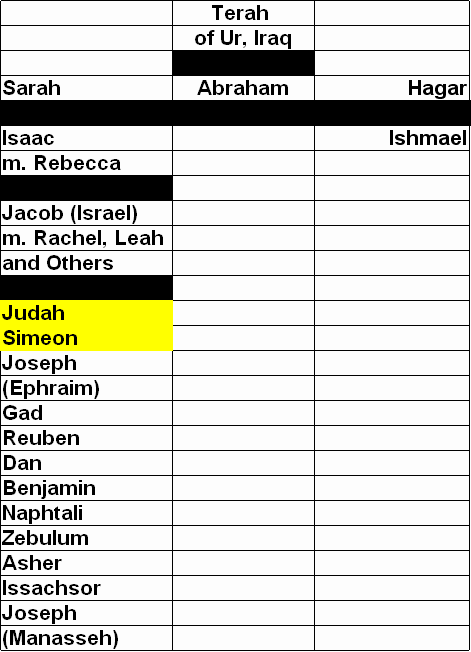
    The following explains the family relationship between the Jews and the Arabs that started about BC 1890 in Ur, Iraq, with Terah, the father of Abraham.

    The tribes of Mecca were the descendants of Ishmael, Abraham's son by Hagar, and from one of these tribes came Mohammed, the founder of Islam.

    The twelve tribes of Israel were the descendants of Isaac, Abraham's son by Sarah, and from Judah -- one of the two remaining of the twelve tribes -- came Jesus, the founder of Christianity.


    Isaac married Rebecca; their son Jacob (Israel) married Rachel, Leah and others.

    From Jacob (Israel)  and his wives came the the twelve tribes, of which only Judah and Simeon are known,

    The ten lost tribes of Isreal are Joseph, Ephraim, Gad, Reuben, Dan, Benjamin, Naphtali, Zebulum, Asher, Issachsor, Manassah.

    Labels: , , , , , , , , , , , , , , , , , ,

    Copyright 2006-2014 Early Civilizations

    jews and moslems are family!

    In that both Jews and Moslems acknowledge Abraham as their founding ancestor, they are essentially of the same Semitic family and inherited not only Abraham's belief in one God but also the Covenant he made with Him.

    Abraham's year of birth is unknown, but is likely to be around 1860 BC. What we do know about Abraham is that he was born in Ur, southern Iraq - during the Sumeric civilization (3500-1700 BC), from which the Babylonian civilization emerged (1500-538 BC) - and was the son of Terah, a wealthy trader in religious idols.

    At an early age, Abraham developed a belief in one God - a belief that was totally alien to his times - and he also had a bad temper. Both his 'strange' belief, his visions and his erratic temper were probably indicative of a mental disorder, and he was therefore lucky to have a loving family to protect him.

    When Abraham became so intolerant of the polytheistic idols in his father's shop that he smashes them in a fit of anger, he raised the wrath of the king who tries to have Abraham burned alive for his disbelief in idolatry.

    Abraham's father, Terah, protects his son by quickly moving the whole family - including his nephew, Lot, and Sarah, Abraham's wife - to Haran in Canaan.

    In Haran, about ten years later, Abraham is commanded by his God to leave his father's house and is promised that his descendants will be numerous. He then travels to Egypt and back, settles in Hebron, grows rich and distinguishes himself as a warrior king - but for all this time he failed to father any children.


    Childless in his old age, and feeling a wretch of a man because of it, Abraham has many visions and conversations with God and finally has a dream where God appears as a smoking torch and commands him to inscribe in blood the sign of the Covenant on his body. The thought of an old man circumcising himself - without anesthetic or surgical instruments - is frightening; but such was Abraham's belief that in doing so, God's promise about many descendants would come to pass.

    The custom of circumcision, then, originated with this Covenant - this plea bargain with God that Abraham made in order to father children.


    In pity at her husband's despair, and what he had done to himself, Sarah offers her Egyptian slave, Hagar, to Abraham for sex - in the hope that a child would ensue. In c.1800 BC, when Abraham was about 60, a son, Ishmael, was born to Abraham and Hagar at Hebron.

    Four years later, c.1796 BC, Sarah herself gave birth to the second son of Abraham, Isaac. The Bible states Sarah's age - like Abraham's - as quite ancient; but common sense dictates that in 1796 BC she was at most 50 and Abraham about 64.

    Abraham was then 'commanded by God' to take his favorite son to Mt Moriah for sacrifice. Actually, the practice of sacrificing children was common at the time and what Abraham was doing was following a pagan custom.

    The Moslems say that Abraham took Ishmael, but the Jews insist it was Isaac, but whichever boy it was, the sacrifice was stayed by God. The Bible claims that God was testing Abraham's faith, but common sense dictates that the poor old man couldn't bear to part with a son he had waited so long for.

    Actually, it is more likely that Abraham chose his firstborn, Ishmael, for the aborted sacrifice because shortly afterwards a jealous Sarah had Hagar and Ishmael banished.


    Ishmael and his slave mother, Hagar, settled in Mecca where Abraham often visited to see his firstborn son. Hagar believed that Ishmael would sire a great nation through 12 sons - the 12 Arab tribes; but the Jews believe that the Covenant only flowed through Isaac and Sarah's lineage.

    The Moslems claim that Ishmael was circumcised - took the blood Covenant - and therefore disenfranchised the Jews. Furthermore, the Moslems claim that God chooses his people on commitment and surrender - not lineage - and that by worshipping the golden calf in the Exodus from Egypt, the Jews proved themselves unworthy of being the Chosen People.


    Mohammed, born 570 AD, the founder of Islam (670 AD), claims to have descended from Ishmael; and Judah, born c.1740 BC, the founder of Judaism (c. 1700 BC), claims to have descended from Isaac through Jacob. Jacob, who changed his name to Israel, was the founder of the nation of Israel and was Isaac and Rebecca's second son. With his two wives and two concubines Jacob fathered 12 sons who, in turn, fathered the 12 tribes of Israel.

    In that part of the world in ancient times - and in some parts, even today - it was the custom for rich men to have many wives and even more concubines and scores if not hundreds of children. Furthermore, in that these were wandering tribes - traveling all over the Middle Eastern lands - their wives and concubines were from all lands, and their children were thus of mixed race.

    Joseph, for instance, was the son of Jacob's 2nd wife, Rachel, and because he was Jacob's favorite he was sold to slave traders by the 6 jealous sons of the 1st wife, Leah, and ended up in Egypt where he gained fame as a dream-reader and became the Pharaoh's 2nd in command. When famine hit Israel, the 6 jealous half-brothers begged for help from Joseph, and he magnanimously forgave them and allowed the Israelites safe passage to Egypt.

    When Seti became King of Egypt in 1304 BC - 43 years after Tutankhamen, 73 years after Akhenaton - he feared the Israelites were outnumbering the Egyptians and ordered all newborn male Israelites to be thrown into the Nile. One child, Moses, was saved and raised by the Pharaoh's daughter, but when Moses grows up and kills an Egyptian for mistreating the Israelites, he flees Egypt but returns when God tells him to lead the Children of Israel out of Egypt. The Pharaoh, Seti's son Rameses II (1290BC - 1224 BC), refuses to free the Israelites, God sends 10 plagues, including the death of every first born Egyptian, including the Pharaoh's, and finally he lets them go, showering them with golden gifts, but changes his mind, goes after Moses, and God saves the Israelites by 'parting' the Red Sea for them to pass through safely.

    In that the ancient Israelites spent time in Egypt and lands now known as Iraq, Syria, Lebanon, Palestine and Saudi Arabia - and freely intermarried or bred with the local people - the likelihood of everyone in the Middle East being closely related to the Jews is significantly higher than it is elsewhere.

    The Moslems and the Jews are indeed not only of the same race but also of the same ancestral families, and as such there is as much bad blood between them now as there was between the families of the Patriarchs.

    Labels: , , , , , , , , , , , , , , , , ,

    Copyright 2006-2014 Early Civilizations

    December 09, 2006

    how much do religions borrow from each other?

    It is no coincidence that the basics of Judaism - and through it both Christianity and Islam - derive from Sumeric literature as well as its legal and moral codes.


    Judah, born c.1740 BC (the son of Jacob, grandson of Isaac and great-grandson of Abraham), was the founder of Judaism and lived during the times of Hammurabi (the great king of Babylon in the civilization of Sumer situated in modern Iraq).

    Abraham was born c. 1860 BC in Ur, in southern Iraq, to a wealthy family who had lived in that area for generations. The family was forced to flee to Haran in Canaan when Abraham aroused the king's wrath - but through the generations, the family of Abraham never lost touch with its homeland.

    When the Hammurabi Code was proclaimed by the king of Babylon, Hammurabi, in 1750 BC, Judah was about 10 years old and he - and his father Jacob - cannot have been ignorant of it, or any of the many Sumeric codes of law that date back to c. 2250 BC under king Ur-Nammu.

    The Hammurabi Code of 1750 BC (inscribed on a black stone pillar which is now located in the Louvre, Paris) is the best preserved and the most extensive of the Sumeric codes. It contains close to 300 laws - covering everything imaginable from military matters to minute personal matters - all of which, of course, are commanded by the gods, in this case the sun-god Shamash, and carry terrible punishments for non-compliance. Hammurabi collected the laws from Babylon's past rulers which, according to the Bible, started with Nimrod - the great-grandson of Noah of the Flood.

    Substitute the many gods of the Sumerian civilization with the one God of the Israelites, Christians and Moslems, and there is a basic similarity between the Hammurabi Code and the Old Testament, Torah and Koran.

    Furthermore, the story of Adam and Eve of Eden - depicted in Judaic-Christian literature - is influenced directly by the story of Enki and Ninhursag of Dimun in Sumeric literature. The biblical deluge story of Noah is also influenced by the story of Ziusudra in Sumeric literature; and the magnificent Sumeric epic of Gilgamesh and Enkidu - a homosexual love story - underlies a great deal of what the developing religions were all about.

    The ideas of heaven and hell, resurrection, an 'eye for an eye' and taking care of widows and orphans - matters that concerned the later Prophets - all came from the Sumerian civilization. The Sumeric word for hell is Kur, meaning a 'foreign land', and considering that Sumer was protected from menacing neighbors by mountains and a river, it is easy to see how hell came to be related to crossing a river and meeting a terrible fate.

    Basically, Judaism took everything it wanted from the Sumeric literature and laws and left the rest; Christianity took everything it wanted from Judaic literature and laws and left the rest; Islam took everything it wanted from Judaism, Christianity and the eastern religions and left the rest; and that is why - despite the unique features they added - they have so many similarities.

    Furthermore, since the earliest known evidence of deity worship was a shrine found in northern Spain, in the El Juyu cave, c. 12,000 BC - 8,500 years before the commencement in c. 3,500 BC of the Sumerian civilization - who is to say how much of their religious rites, laws and creation stories the Sumerians borrowed from the European tribes migrating to warmer southern lands after the Ice Age ended?

    Between the final recession of the Ice Age in 12,000 BC and establishment of the first civilization - the Egyptiac in c. 4000 BC - vast trade and migration routes had been opened up, and with the European migrants and traders came ideas that were far in advance of anything known elsewhere.

    Before writing, which the Sumerians invented, everything was necessarily passed on from generation to generation orally - usually in the form of stories to make them easier to remember; and there is plenty of evidence, too, that early art forms are attempts to convey the culture and laws of those who drew them - either as adjuncts to the stories or as stand-alone truths.

    Labels: , , , , , , , , , , , , , , , , , ,

    Copyright 2006-2014 Early Civilizations

    December 08, 2006

    the first religions had many gods

    The first archeological evidence of religious worship was found in northern Spain where a shrine was found in El Juyu cave and dated 12,000 BC.

    Before the idea of one God was first established c. 1850 BC by Abraham - the founding father of both the Jewish and the Moslem peoples - the mode of worship was similar in all parts of the world. There was no organized religion per se other than polytheism - otherwise known as Paganism.

    In India, polytheism evolved to form the religion of Hinduism (or Brahmanism) which dates from the Bhagavad-Gita of 3102 BC in which, according to tradition, the god Krishna defined the rigid caste system that, despite democracy, still permeates Indian life.

    Polytheism, or Paganism, is the worship of many gods - relating to fertility, manhood, harvest, riches and protection from ills. Similar idols relating to each type of god or goddess were found in the shrines of disparate civilizations. That the gods were fashioned from human or animal forms - and were similar in civilizations separated from each other - is understandable. To ascribe to a god a human form is, apparently, a human trait.

    The female idols - the goddesses - were more numerous than those of animals depicting the strength or phalluses of manhood. This may indicate that religion was primarily a pastime of women but, on the contrary, because much of it was highly erotic - and men have traditionally had more time on their hands than women, who were burdened with bearing, nursing and raising small children - religion was mostly a male pastime.

    The Canaanite idols worshipped were principally Baal, represented either by a bull or a phallic stone, his consort Astarte, the fertility goddess and Moloch, the child-devouring god. Similar to religious practices all over the ancient world, burnt offerings and sacrifices were made to these gods in return for power, riches, prestige and victory. One of the ancient Canaanite and Sumeric gods, Tammuz, the god of the dying, curiously remains with the Jewish religion in the form as a month in the Jewish calendar.

    The practice of human sacrifice was common to most ancient religions, but infant sacrifice was particularly common. Even Abraham, back in c.1790 BC, was 'commanded' by God to sacrifice his son; in the 9th century BC, when Ahab was the King of Israel, he and his wife Jezebel sacrificed two sons on the altar of Baal; and both King Ahaz and King Manasseh (who sawed the Prophet Isaiah in two during his reign 687-642 BC) ritually sacrificed children to Moloch in the Valley of Hinnom, south of Jerusalem.

    Modern religions may have abolished human sacrifices, but blood still plays an important part in worshipping God. Childless Abraham started the Jewish practice of circumcision as a Blood covenant with God in return for the promise of children - which the Jews still follow, as do the Moslems, and a lot of Christians adopted, too - but the Christian Church initiated another practice, the Eucharist, drinking the blood and eating the body of Christ - a rite that causes many to consider it a cannibalistic religion.

    Labels: , , , , , , , , , , , , ,

    Copyright 2006-2014 Early Civilizations